


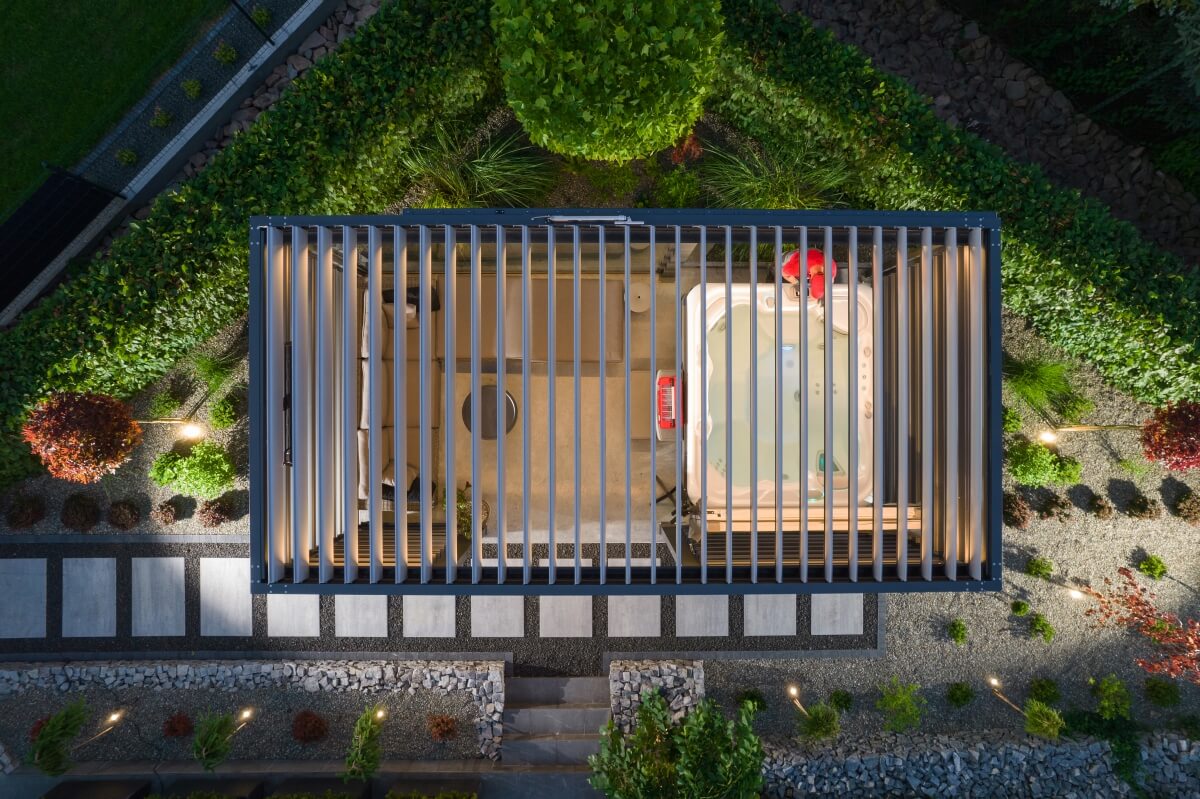
Louvre roofs are growing in popularity because the rotating louvres allow you to adjust the shade and airflow, and when it rains, the roof can be closed, with water drained away via concealed gutters. The choice depends on the type of structure – freestanding or wall-mounted – and whether it is operated by a crank or a motor. The structure requires stable materials, such as KVH or BSH, and beams selected to suit the span and wind load zone.
Do slatted canopies really improve patio and garden comfort?
Louvre canopies have become one of the most popular choices for terraces, as they offer what fixed canopies generally lack: control over light, ventilation and protection from the rain.
Dąb Gaj Wood designs these structures with everyday use in mind – so that they not only look good in the visualisations, but also remain functional after several seasons, in the sun, wind and after a downpour.
If someone asks me where to start, I usually say: first determine whether you are interested in a freestanding or wall-mounted version and how you want to control the fins. In practice, the most convenient system canopiesbecause they have refined mechanics, predictable water routing and are easy to fit into a new or finished terrace.
How do slatted canopies work and what does slat adjustment offer?
Louvre canopies function as a roof made up of movable slats (louvers) that rotate on an axis and change their angle of inclination. This allows for a quick transition from full sunlight, through gentle shade, to closing the roof completely when it rains.
In practice, the ability to adjust the slats is the main reason why slatted canopies are replacing traditional pergolas with polycarbonate or fixed roofing.
In typical installations, you’ll find either manual operation (a crank) or electric operation (a motor and remote control). Manual operation is cheaper and requires less maintenance, whilst electric operation offers greater convenience, particularly if the roof measures, say, 4 × 5 m and you use it every day.
The slats themselves usually rotate within a range of around 0–120 degrees, which allows you to create shade without turning the terrace into a dark cave.
An important installation detail: when the slats are closed, the water must have somewhere to drain away. Well-designed slatted canopies have concealed gutters in the perimeter beams and a drain in the post, preventing water from pouring over the front edge.
This isn’t just a cosmetic issue – it’s the difference between a terrace you can use in the rain and one where, after 10 minutes, you’ve got puddles by the door.
Why are fin canopies more durable than classic fabric or polycarbonate pergolas?
Louvre canopies are more durable mainly because they do not function like a membrane (fabric) and do not age in the same way as plastic panels. The slats and frame form a rigid structural system that withstands wind well, and provided water is drained properly, there is no problem with moisture build-up.
As a result, louvre roofs can realistically last for 15–25 years, provided the structure is sound and maintenance is carried out regularly.
When it comes to timber, two factors are crucial: dimensional stability and weather resistance. That is why KVH or BSH structural timber (e.g. GL24) is used in premium constructions, as it is kiln-dried, planed and behaves predictably.
In practice, a post with a cross-section of 18 × 18 cm provides a clear margin of stiffness for larger spans, and the beams are selected to suit the roof dimensions and wind zone, rather than relying on a rough estimate.
If you compare it with fabric: fabric loses tension over time, gets dirty, and needs to be looked after in snow and strong winds. Polycarbonate, on the other hand, can make noise in the rain, catches scratches and sometimes tarnishes after years. Fin canopies win out because they are breathable and offer real protection, without the greenhouse effect.
- Wind resistance: the rigid frame and laths withstand gusts better than the fabric, which acts as a sail.
- Light control: instead of a fixed shadow, you have daytime adjustment, which you will appreciate with southern exposure.
- Fewer dirt problems: easier to wash the laths than to clean the fabric or replace yellowed panels.
How much do lamella roofs cost and what does the installation quote depend on?
Louvered canopies usually cost more than simple fixed canopies, as you are paying for the mechanical components, precision and water drainage. The price increases with the size of the canopy, and the differences stem from the type of control system, the method of installation, the finish of the timber and any additional features.
The quote is also affected by whether the structure is to be built on existing footings or foundations, or whether the ground needs to be prepared from scratch. If the terrace is already finished with decking or slabs and there are no load-bearing points for the posts, earthworks and foundation work will be required.
In practice, concrete footings are cast beneath the posts below the frost line (often 80–120 cm, depending on the region), and anchors are used to ensure the timber is raised off the ground so that it does not stand in water.
When it comes to the structure itself, it is not only the size that matters, but also the spans. A 6-metre-long roof without intermediate supports requires a different beam and places different stresses on the material than a 4-metre-long roof.
If you add side screens, wooden blinds, a system of movable slats or slatted structures, not only does the cost increase, but so does the functionality – because slatted canopies begin to function as a fully-fledged summer room.
- Controls: manual is cheaper, electric raises the cost but gives convenience for daily use.
- Dimensions and spans: the larger the area and fewer supports, the larger the sections and the higher the price.
- Ground preparation: foundations, anchoring and drainage can make up a noticeable part of the budget.
How do you maintain your lamella roofing to keep it looking good for years to come?
You can keep your louvre canopies in excellent condition by treating them as part of the façade: wash them regularly and refresh the protective coating from time to time. The most important thing is to prevent dirt and moisture from accumulating in the nooks and crannies around the slats, gutters and joints.
With the right wood preservative and oil-based stain, practical maintenance is usually required once every 1–3 years, depending on exposure to sun and rain.
In practical terms, it works like this: in spring, you wash the structure with a mild wood cleaner, check the drains and gutters, and then assess the finish. If there are signs of significant drying out or a reduction in water repellency in the areas most exposed to the sun, apply a thin coat of oil or wood stain.
On south-facing terraces, this is usually done more often than on north-facing ones, as UV radiation is relentless even for the best system.
An important point to bear in mind during installation: it’s not worth waiting until the wood starts to turn grey unevenly. It can still be salvaged at that stage, but it requires more work (cleaning, and sometimes light sanding). It’s better to keep the finish in good condition and have louvre canopies that, after 5–8 seasons, still look like a premium product rather than a structure that’s seen better days.
If you're planning a canopy for years to come, it's also a good idea to take a look at the moving parts once a season: whether the laths are working evenly, whether nothing is rubbing, whether the water drain is unobstructed. Mechanics like cleanliness and a simple check, and such a minor routine saves nerves in the middle of summer when the terrace is just supposed to work.
In a well-designed terrace area, louvre awnings make all the difference from day one: they provide shade, ventilation and protection when you need them, not just when the weather permits.
If you want to choose the size, installation method and finish so that the whole thing matches your home and garden, the safest option is to rely on a solution that has been tried and tested in production and installation – in Dąb Gaj Wood Often we just start by talking about how you really use your terrace and what you expect from a slat adjustment.
Read also: Do timber decking developments work all year round?
Frequently asked questions
How long does it take to complete a lamella roof from measurement to installation?
More often than not, you have to reckon several weeks from measurement and arrangements to installation, and the timeframe depends on the season and the degree of personalisation. The on-site installation itself usually takes 1-3 days if the foundations and foundation are ready. When you have to make the concrete footings and wait for the concrete to set, the whole process can add another few days.
How do I prepare the ground and foundations for the lamella roofing columns?
Punctual concrete footings below the frost zone are usually made for the posts, usually at a depth of approx. 80-120 cm depending on the region. If the terrace is already finished and there are no load-bearing points, it is necessary to make provision for stripping or making foundations next to the terrace and anchoring accordingly. It is also important to use anchors and distance from the ground so that the wood does not stand in water.
Is it better to choose a manual or electric control for the fins?
Manual control (crank) is cheaper and easy to operate, so it works well for smaller roofs and occasional use. Electric (motor and remote control) gives more comfort, especially on larger roofs, e.g. about 4 × 5 m, when you adjust the slats several times a day. In practice, the choice depends on how often you use the terrace and whether you want maximum adjustment convenience.
Which timber to choose: KVH or BSH for lamellar construction?
For premium construction, KVH or BSH is the most common choice, as it is a kiln-dried and planed timber that is predictable for outdoor use. BSH (e.g. GL24) tends to be a better choice for longer spans, as it is more dimensionally stable and can carry loads safely. The final choice of section and material should take into account the dimensions of the roof and the wind zone.
How often do I need to maintain and oil the lamella roofing?
Refreshing the coating every 1-3 years is most often sufficient, and the frequency depends mainly on the sun and rain. In practice, south-facing terraces usually require more frequent maintenance, as UV radiation weakens the water repellency and colour more quickly. A good routine is spring cleaning, inspection of gutters and downspouts and a quick reaction before the wood starts to grey unevenly.