


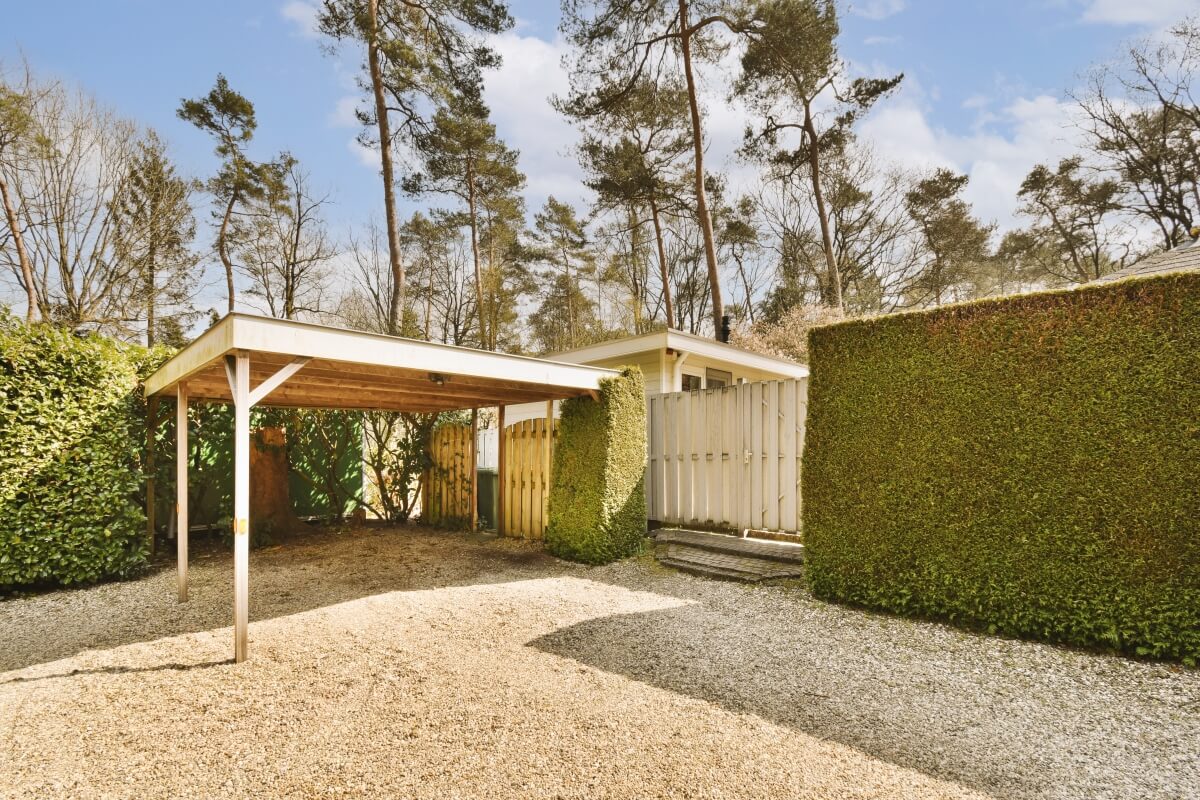
Structures made of wooden planks are suitable for year-round use provided they have clearance from the ground, planks of sufficient thickness and a stable grating anchored to posts. Year-round suitability depends on ventilation, drainage, the UV resistance of the finish, and fixings that do not restrict the natural movement of the timber. The load-bearing structure is made from KVH or BSH, whilst the cladding boards are made from larch or spruce with treated cut edges.
Are timber decking developments a good solution for all seasons?
Timber decking can work all year round, but provided it is well designed, made of the right timber and regularly protected. In practice, this is not a decoration for the summer season, but a full-fledged structural element of a garden or terrace that is meant to work in rain, frost and sun.
Dąb Gaj Wood designs these projects with year-round use in mind: from the selection of cross-sections, through the method of fixing, to the application of a protective coating. If you’d like to see what they look like wooden plank buildings in practice and which options clients most often choose, it is worth starting with examples and tailoring the solution to the site.
How do wooden plank developments stand up to rain, snow and harsh sun?
Wooden decking can withstand the year well if it has ventilation, proper drainage and UV protection. The biggest enemy is not the water itself, but the long retention of moisture in the nooks and crannies and the scorching sun, which degrades the coating and dries out the surface.
Definition from the contractor’s perspective: a year-round structure is one in which the decking boards do not stand in water, are raised off the ground and are not rigidly fastened in a way that restricts the natural movement of the timber. In practice, a gap is left between the decking and the ground (usually 20–40 mm), and the boards themselves are fitted onto a grid, ensuring that expansion gaps are maintained.
With boards laid vertically, it is easier to drain water away, whilst with horizontal boarding, particular care must be taken with the drip edges and the finishing details.
The dimensions that work best in gardens and on patios: cladding or decking boards approximately 20–28 mm thick, a framework made from 40×60 mm or 45×70 mm square timber (depending on the height and wind loads), and corner posts usually 9×9 cm or 12×12 cm.
If the cladding is also intended to reinforce the structure of a gazebo or pergola, larger cross-sections are required, as the boards then serve as a cladding element rather than a load-bearing one.
Snow and frost by themselves do not damage the wood as quickly as wet/dry cycles. Therefore, installation distances, no ground contact and a good coating are important. In the summer, on the other hand, UV radiation causes greying and micro-cracking, so without oiling or staining, wood decking developments lose their premium appearance more quickly.
Which timber and what grade of timber is used to make timber plank buildings for years to come?
Timber board cladding for years to come is made from dimensionally stable, chamber-dried timber and well suited to the role: the board for the casing is one thing, the supporting structure is another. Ideally, the structural elements should be of KVH or BSH (e.g. GL24) and the sheathing planks of a hardy species and correctly protected.
Practical definition: the superstructure is responsible for rigidity and safety, and the boards are responsible for shelter, privacy and appearance. If someone saves on the structure and gives random wet wood, the building starts to work, catches twists and gaps become uneven.
You will most often encounter such material options:
- Spruce/pine for the structure (KVH, BSH) - stable, predictable in assembly, good for load-bearing elements; with 12×12 cm or 18×18 cm columns it makes a really solid base.
- Larch for shelter boards - naturally more resilient, ages nicely, but also works and can surface crack if poorly installed or left unprotected.
- Spruce for shelter boards - budget and aesthetically pleasing, but needs consistent waterproofing and more frequent maintenance, especially on the south side.
If you want durability, pay attention not only to the species, but also to the details: the way it is dried, the selection (fewer knots in sensitive areas), the chamfering of the edges and whether the board has a sensible thickness. In wooden decking, a board that is too thin can ripple, and one that is too wide without expansion joints will show the wood working more quickly.
How do you install timber decking so that it is stable in winter and does not steam up in summer?
Timber board cladding installs stably when it has a rigid grid, correct spacing and corrosion-resistant fixings. The key is to leave room for the wood to work naturally and not to lock moisture into the joints.
Installation definition: a decking frame consists of a system of vertical or horizontal battens or square-edged timbers to which the decking boards are screwed, and the whole structure is anchored to posts or a wall. For heights of 2.0–2.4 m, the standard spacing between grating elements is approximately 40–60 cm, depending on the thickness of the plank and the wind zone.
The more exposed the location (an open plot, the corner of a building), the more important it is to increase the density of the grid and add stiffeners.
In practice, year-round sustainability is affected by such things:
- Clearance from the ground - leave 20-40 mm clearance so that the board does not drag water from the paving, ground or terrace and so that it can be washed normally.
- Fasteners - stainless steel or structural galvanised screws are a must; black panel screws quickly come out with rust and make stains.
- Working gaps - gaps (often 3-7 mm) are left when installing, as wood swells in summer and dries and shrinks in winter.
- Protect the cuts - any cut at the end of a board is the place that absorbs water the fastest, so it is worth saturating it with a protectant before installation.
If the wooden plank buildings are part of a larger structure (e.g. at a pergola or gazebo), it is good to anticipate where the wind will work. Sometimes extra squared timber is all that is needed, sometimes it is better to change the arrangement of the boards to vertical, as it acts as a better shelter from the driving rain and collects less dirt on the edges.
How do you maintain wooden decking developments so they look good all year round and how much does it cost?
You can keep your wooden decking in good condition all year round if you protect it with a UV and moisture-resistant coating and refresh it regularly. Realistically, with exposure to the sun, maintenance is usually done every 1-3 years, and even less frequently in sheltered areas.
Utility definition: maintenance is not only about oiling, but also about washing, checking joints and reacting quickly to damage to the coating. More often than not, the problem starts with the little things: a splinter after an impact, a rough cut after fitting a board on site, or a spot where water stands after rain.
Approximate costs (to give an idea of the scale, without going into hundreds of different options): fitting out a structure approximately 3 m wide and 2 m high (6 m² of cladding area) usually costs several thousand zlotys, depending on the type of timber, the layout (vertical/horizontal/slatted), the type of construction and whether doors, corner pieces or cover panels are included.
The cost of the materials alone usually amounts to between several dozen and several hundred zlotys per section (wood treatment product + accessories), whilst the labour costs depend on accessibility and the condition of the finish.
The lifespan of a well-made building is quietly calculated in decades if there is no contact with the ground and the protective coating is maintained. Without maintenance, the wood will continue to stand, but it will go grey more quickly, catch colour unevenness and, in extreme cases, start to catch cracks and localised weakness at the ends.
If you want peace of mind all year round, the most important thing is to match the solution to the conditions on the plot and have a sensible maintenance plan, rather than chasing the hardest species. When you need help choosing a layout, timber and finish, contact Dąb Gaj Wood and tell us where you want the building to stand and how it should work in your space.
Read also: What are the functions of timber sheds with a roof at the house?
Frequently asked questions
Does the planked cladding require preparation of the substrate before installation?
Yes, the key is to ensure that the boards are spaced from the ground and that there is space for water to drain away so that moisture does not build up at the bottom edge. It is most common to leave a clearance of 20-40 mm from the paving, terrace or ground and plan access to wash this area. If the ground is soft or uneven, it is a good idea to make stable fixing points (e.g. footings for posts) beforehand instead of resting the structure directly on the ground.
How long does it take to realise and install a timber decking development?
The installation of a typical structure at the terrace itself usually takes 1-2 days, depending on the length, number of corners and finishing details. Preparation time for the elements and lead times depend on the timber chosen, the finish and whether the structure is part of a pergola/altana. To avoid problems in winter, it is advisable to plan the installation so that the cuts are secured straight away and correct working joints are made.
How often does the coating need to be renewed to make the building all-round?
Most often the coating is refreshed every 1-3 years, and on façades with strong sunlight it is usually closer to 1-2 years. In areas sheltered from rain and UV, maintenance may fall off less frequently, but it is still worth doing an inspection after winter. The most important thing is to quickly protect damage and rough cuts, as these catch moisture most quickly.
Is it better to choose KVH/BSH or plain wood for the structure under the boards?
KVH or BSH are better suited for load-bearing structures, as they are dimensionally more stable and behave more predictably throughout the year. Ordinary wet timber is more prone to warping and can cause gaps to widen, which makes the structure look less attractive and more difficult to maintain. Cladding boards can be chosen separately (e.g. larch or spruce), but the structural framework should be as stable as possible.
Is it possible to adapt the dimensions, board layout and colour to the conditions on the plot?
Yes, the development is usually tailored to a height of 2.0-2.4m, the wind zone and whether it is to shield from rain or mainly give privacy. The vertical arrangement drains better, while the horizontal requires detailing (drips and ends), so the choice is worth depending on the weather exposure. The colour and type of coating is chosen according to the sun exposure, as on a south-facing site the coating wears off more quickly and may need to be refreshed more often.