


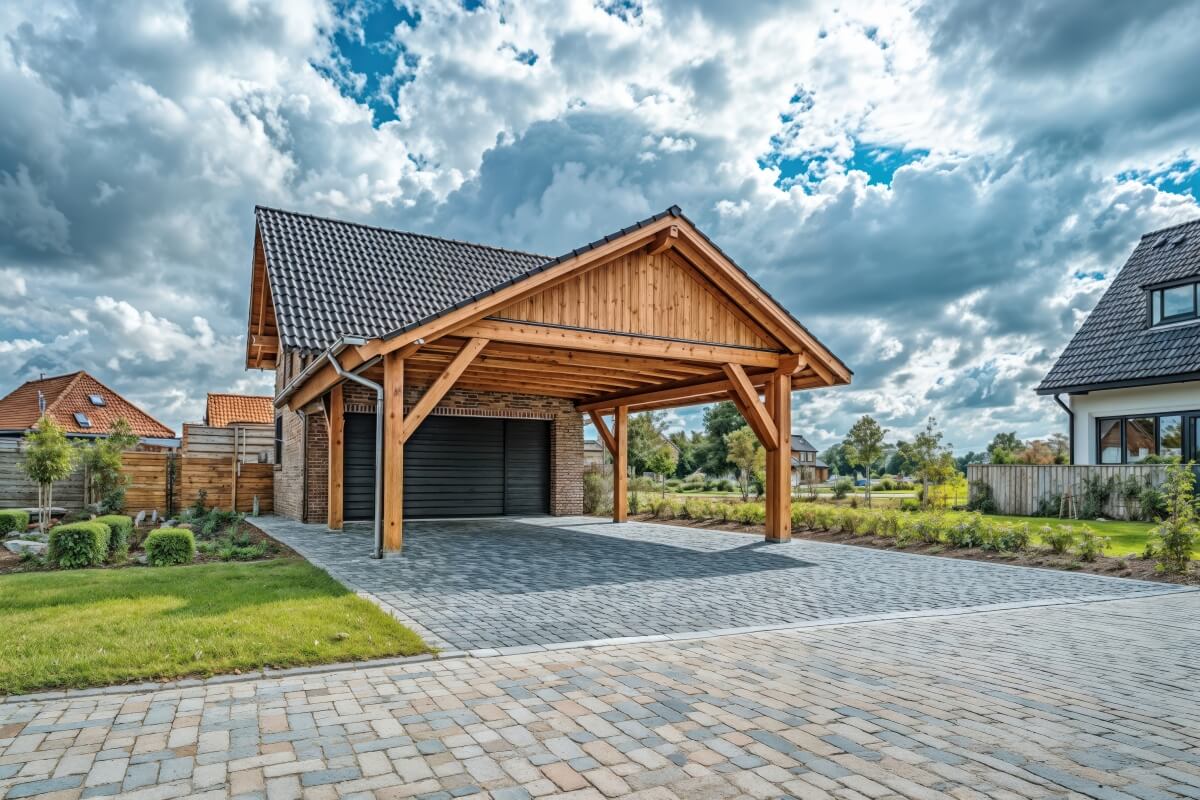
Wooden carports attached to the house create a covered utility area: they protect the car and walkways from the rain and sun, and provide a tidy place to store firewood, bicycles and equipment. The choice of solution depends on the intended use, the location next to the façade, wind and snow conditions, and the direction of water drainage. Stable cross-sections, bracing and anchoring to foundations suited to the span are crucial.
Why are timber sheds with a roof next to the house so popular today?
Wooden sheds with a roof are one of those solutions that really organise the space around the house: they protect, organise and increase the comfort of daily use of the garden and driveway. In practice, they act as a covered buffer between the house and the surroundings, and with well-chosen dimensions can replace some of the functions of a garage or covered terrace.
Dąb Gaj Wood designs and manufactures wooden sheds with roof so that they are tailored to the building’s structure, the wind conditions and the way the household actually uses the driveway and garden.
In this guide, I outline the key functions that such a structure can fulfil around the home, and what to look out for to ensure your investment is durable and convenient to use.
What functions do timber sheds with a roof at the house perform on a daily basis?
Timber sheds with a roof primarily protect against rain and sun, but their role usually expands quickly: from parking the car, to roofing the entrance, to a place for wood, bikes or garden equipment. A well-planned shed tidies up traffic around the house and reduces clutter on the driveway.
The definition in practice is simple: a shed is an open or partially enclosed post-and-beam structure with a roof, either set against the wall of a building or as a free-standing shed. If it stands next to a house, it usually takes over the function of the technical and utility area.
The most common features that customers appreciate after the first season:
- Protecting your car from snow, rain and UV. The car heats up less in summer and there is no need to scrape the windows in winter; the roof makes a bigger difference here than many people think.
- Roofing the entrance area. Wooden sheds with a roof at the door are a convenience when bringing in purchases and a safer entrance, as the steps are not so slippery after rain.
- Roofed storage. Firewood, baskets, bicycles, trolleys and tools can be kept under a shed; the important thing is to provide for ventilation and sensible access.
- A buffer zone between the house and the garden. Wooden sheds with a roof often make for a place to quickly change shoes, put away wet things or temporarily put away equipment.
For these functions to work, proportions are key. For one car, a sensible usable light width is usually 3.3-3.8 m and a length of 5.5-6.0 m. For two cars, 5.8-6.5 m width and a similar length usually works well. It is advisable to keep the height of the drive aisle around 2.2-2.4 m, and to plan the roof itself so that water does not pour onto the drive aisle.
What to look out for to ensure that timber sheds with a roof are stable and safe?
Timber sheds with a roof are stable when they have the correct column and beam cross-sections, correct bracing and solid anchorage in the foundation. Without this, even a nice structure will work in the wind, and years later, loose fasteners and creaking can occur.
The definition of a carport’s stability is a combination of three factors: load-bearing capacity (i.e. the roof’s load-bearing capacity), rigidity (whether it sways from side to side) and the durability of the joints. In practice, posts with a cross-section of 18×18 cm are most commonly used, as they provide a good margin of rigidity and withstand wind and snow loads well, particularly over larger spans.
Elements that make a real difference in use:
Firstly, structural timber. In high-end constructions, KVH or BSH (e.g. GL24) is used, as it is dimensionally stable and less prone to warping and cracking than ordinary sawn timber. Secondly, span lengths.
If you want lighting without a central pole, the beams must be calculated to suit the specific roof and local loads; for wider spans, glued laminated timber (GLT) is often used.
Thirdly, the foundations and anchoring. You’ll most commonly find point foundations or a continuous footing, with the posts resting on steel anchors above ground level. This is important because the timber shouldn’t absorb moisture from the concrete. Fourthly, the roof. The pitch and eaves are no mere detail: eaves of 30–50 cm provide better protection for the structure and façade, whilst a sensible pitch facilitates the drainage of water and snow.
How much do timber sheds with a roof cost and what influences pricing?
The price is determined by the dimensions, the grade of timber (KVH/BSH), the type of roof, the number of panels or slats, and how well it fits the house.
The definition of pricing is simple: you pay for material, treatment, timber protection, fasteners, roofing, foundations and installation labour. The biggest differences are made by the spans (i.e. the thickness and type of beams) and the roof, because it is the one that carries the loads and needs to be carefully constructed.
Indicatively, for typical sizes it looks like this:
If side panels, slatted panels, storage compartments, gutters, lighting or a bespoke stain colour scheme are added, the cost increases, but so does the functionality.
It’s worth bearing one thing in mind: wooden carports with a tongue-and-groove roof are often cheaper to begin with, but less convenient. An extra 30–50 cm in width can make all the difference when it comes to day-to-day parking, and that’s a difference you’ll notice for years to come.
How do you maintain wooden sheds with a roof so they last 20-30 years?
Timber sheds with a roof can easily last 20-30 years if the timber is well protected and regularly renewed. In practice, the key points are: correct impregnation at the start, inspection of sensitive areas and refreshing the coating every few seasons.
The definition of maintenance is not just painting. It's also making sure that water doesn't pond on the elements and that the wood has the conditions to dry out. Most problems do not come from rain, but from prolonged dampness in the nooks and crannies: at the joints, at the floor, under the guttering without slope.
A schedule that works:
- Inspect once a year, preferably after winter. You look at the posts at the anchors, the joints, the edges of the roof and check for cracks, chipping of the coating and play on the fasteners.
- Refresh the coating every 3–5 years, depending on exposure to the sun and rain. The south and west-facing sides are always more exposed, so refurbishment is often needed more frequently there.
If the structure is stained and oiled with a good grade system, the wood greys more slowly and is less prone to micro-cracks. It is also worth keeping an eye on the installation details: the offset of the post from the ground, the eaves, the guttering and the absence of places where water stands flat. These are the little things that make the biggest difference in real-life use.
Finally: don't be afraid of the natural working of the wood. Small cracks or micro cracks are normal. The problem only starts when the coating is neglected and water enters the material over the years.
If you want the carport next to your house to fulfil several functions right from the start and still look good year after year, it’s worth basing the design on tried-and-tested cross-sections, good-quality structural timber and well-thought-out roof details.
It carries out projects such as these Dąb Gaj Wood - from matching the dimensions to the driveway and the shape of the building to installation and maintenance tips so that the structure works smoothly for years to come.
Read also: Do wood gazebo walls increase privacy?
Frequently asked questions
Can a shed next to a house replace a garage in everyday use?
In many homes, the shed takes over most of the functions of the garage, as it protects the car from snow, rain and sun and makes everyday parking easier. However, it's important to remember that a shed doesn't provide full enclosure and insulation, so it won't replace the garage as a warm storage area or burglar proofing. If you're after a storage function, it's worth planning a side wall, slatted enclosure or separate storage area from the outset.
How do I prepare the ground and foundations for a timber shed next to the house?
Point foundations or continuous foundations are most commonly made and the posts are placed on steel anchors so that the timber does not come into contact with the moisture in the concrete. Before installation, it is a good idea to have the foundation points ready and levelled and the slopes of the pavement planned so that water does not stand against the posts. If there is paving on the driveway, it is usually necessary to make provision for demolition at the footings and reconstruction of the surface once the concrete has set.
How long does it take to complete and install a timber shed with roof?
The on-site assembly itself usually takes 1–3 days, depending on the size of the carport, the type of roof and whether side walls or extensions are included. On top of this comes the time needed to prepare the foundations, which in practice means a few working days plus a waiting period for the concrete to set. The overall completion time depends on the contractor’s workload and the level of customisation, but it is worth bearing in mind that a bespoke project requires planning well in advance.
Which timber to choose for the shed: KVH or BSH and when does it matter?
KVH is suitable for most standard carports, as it is dimensionally stable and performs well in post-and-beam structures. BSH (e.g. GL24) is worth considering if you require larger spans, fewer posts and beams, and no deflection under a heavier roof. In practice, the choice of material should be based on calculations for specific wind and snow loads, as well as the planned unsupported span.
How often does the coating need to be renewed and what affects the life of the shelter?
The coating is usually refreshed every 3-5 years, and on sunny sides (south and west) it is sometimes necessary more often. Durability is most influenced by the details: eaves 30-50 cm, correct roof pitch, gutters and the offset of the wood from the ground on steel anchors. Once a year, it is a good idea to do a quick inspection after the winter and react immediately to any chipping of the coating or areas where water may be lingering.