


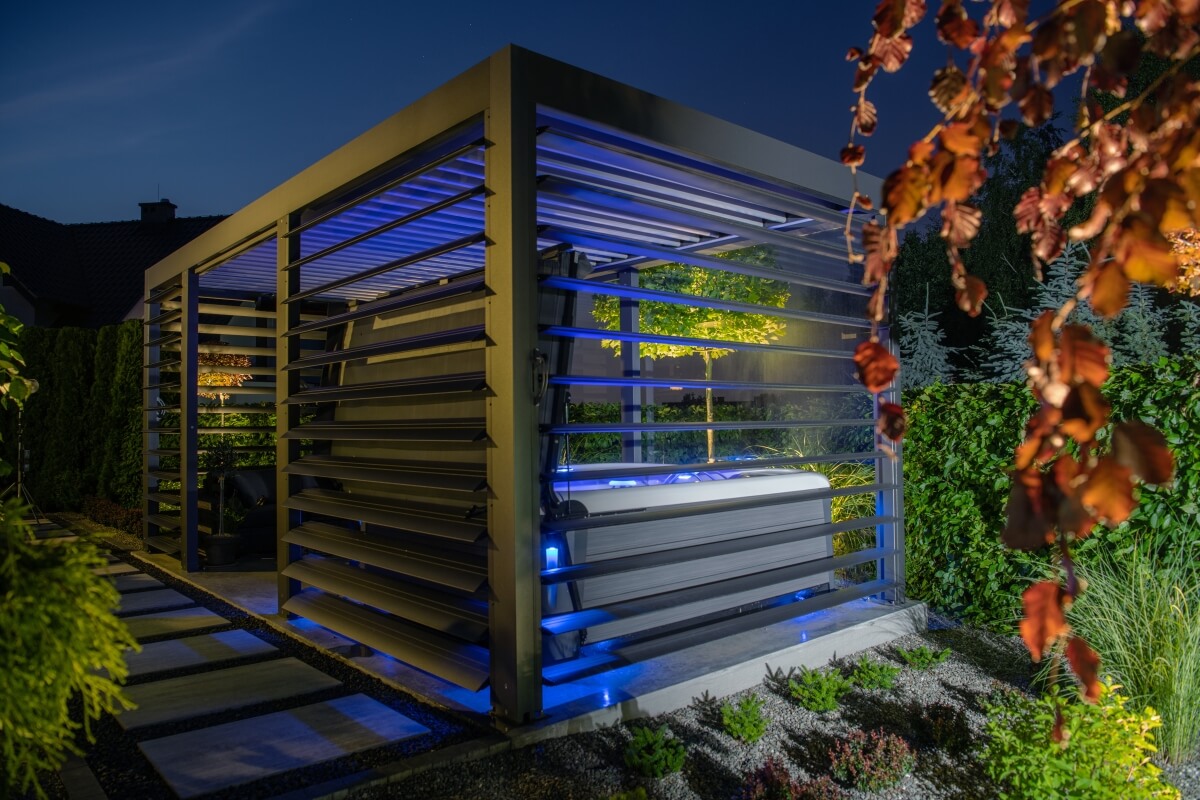
Terrace blinds with a movable mechanism are a good choice if the terrace is to serve different purposes during the day: sometimes opening out onto the garden, and at other times providing shelter from the sun, wind or the view of neighbours. If one side is to be screened off at all times, a fixed wooden panel will prove a simpler solution. Where rain falling from above is a problem, a canopy is essential.
When movable slats are preferable to a fixed cover
A retractable louvre requires more work in terms of design and construction than a fixed wall, as it consists of a frame, an axle and a mechanism. This difference pays off where conditions on the terrace change several times a day. Typical situations include:
- a terrace facing west or south, where the afternoon sun shines low, under the eaves;
- a neighbour’s building close to the boundary of the plot, whilst wishing to retain the view of the garden;
- a dining area with a barbecue, where sometimes you need a draught and sometimes shelter from the wind;
- the large windows in the living room, which get very hot in summer;
- a terrace used from morning to evening, not just at the weekend.
In each of these situations, a fixed awning forces a compromise: either there is shade and no view, or a view and full sun. Adjustable patio blinds allow you to change this choice as and when you wish.
An article on this subject shows how it works in practice, at different times of day and in different weather conditions, What are the functions of wooden patio blinds?.
Patio blinds, panels, roller blinds and canopies all in one overview
A retractable awning is just one way to create a sheltered terrace. Each solution serves a different purpose and has its own limitations:
| Solution | What does it regulate? | When it works | Restriction |
|---|---|---|---|
| Adjustable blinds | Light, views and a draught | Needs change throughout the day | They require a rigid frame and proper maintenance of the mechanism |
| Solid panels or walls made of planks | Nothing; the cover remains the same | One side must always be covered | No adjustment of light or draughts |
| Wooden blinds | Degree of obstruction of the opening | The opening is sometimes completely exposed | A rolled-up blind does not provide any cover |
| Louvre roofing | Light coming from above | The blazing sun at midday | It does not provide cover for the sides of the terrace |
These solutions are combined. A common arrangement is a canopy over the terrace and adjustable blinds on the side facing the sun or the neighbour, whilst on the garden side there is either no cover or a lightweight roller blind.
The page shows a permanent wooden shelter a terrace enclosure made of wooden panels, and a solution that provides protection from above: terrace roofing.
When a simpler cover is quite sufficient
Adjustable slats are not always the best choice. A fixed panel or fixed slats will work better when:
- the wall facing the neighbouring building or garage must be screened at all times;
- The terrace is mainly used in the evenings, when the sun is no longer a problem;
- there is no rigid structure to secure the frame to, and building new posts is not an option;
- The priority is to minimise the number of components requiring maintenance.
A fixed cladding also needs its finish refreshed, but it has no axles or fittings that require maintenance. In simple, modern designs, the even rhythm of the boards is, in fact, an asset in its own right.
This thread expands on the discussion of whether Wooden decking panels are ideal for a minimalist design.
What to consider before ordering patio blinds
To get an accurate quote, there are a few details you should gather in advance:
- The dimensions of the openings between the posts or against the wall, and whether the posts are vertical.
- The cardinal direction and the direction from which the wind most often blows.
- The main purpose of the awning: shade, privacy or protection from the wind. The spacing of the slats and the degree to which it is closed depend on this.
- Method of attachment: to pergola posts, to a building wall or to a new structure.
- Colour and finish to match the façade or the decking.
Wide openings are usually divided into several sections, as long sections are more prone to sagging and becoming misaligned. The foundations for the new posts, i.e. the footings, are to be provided by the client, whilst the scope of the remaining work is determined at the time of quotation.
Pricing is determined on a case-by-case basis and depends on the dimensions, fillings and finish. The text breaks down the cost factors into their constituent parts Are made-to-measure wooden blinds worth the price?.
Louvres as the walls of a gazebo or pergola
Movable slats do not have to be attached to the house. In a free-standing gazebo, they form walls that can be opened or closed depending on the weather, whilst in a pergola they provide shade on selected sides.
In the model Modern garden arbour Blinds with adjustable light control are one option for wall cladding. The gazebo can also be extended with an additional module in the form of a pergola.
The Dąb Gaj Wood models are constructed from GL24 SI BSH glued laminated timber and KVH timber, joined with steel connectors and anchored to concrete using adjustable mechanical anchors. The design of the gazebo walls is described in a separate article on how to select wooden blinds for a gazebo.
The different versions are shown on the website patio blinds with a sliding mechanism. Marzena Mielnik (+48 728 833 444, m.mielnik@dabgaj.pl) is preparing the valuation for the Polish market, whilst Beata Buczkowska is preparing it for the German market (+48 692 007 848, b.buczkowska@dabgaj.pl).
Frequently asked questions
Are retractable patio blinds better than fixed panels?
They are better suited where needs change throughout the day, whilst fixed panels are the better choice when one side needs to be covered at all times. Blinds allow you to control the light, the view and the draught, but require a rigid frame and regular maintenance of the mechanism. A panel is simpler and has no moving parts.
Can the adjustable slats be combined with the canopy?
Yes, it’s one of the most practical combinations. The canopy provides protection from above, whilst the blinds shield the sides from the low sun, the wind and prying neighbours. It’s worth planning both elements together to ensure that water from the roof doesn’t run down onto the slats.
Will patio blinds work on a windy plot?
They work well if the frame is rigid and the structure is securely anchored. In strong gusts, the slats should be set at a slightly tilted angle so that they allow some of the wind to pass through rather than acting like a sail. It is better to divide wide openings into several smaller sections.
Do patio blinds require foundations?
Foundations are required when the blinds are to be mounted on new, free-standing posts. The foundation bases are to be provided by the customer. When fixing the blinds to a building wall or an existing pergola, it is necessary to check whether these structures can bear the additional wind load.
How much do patio blinds with a retractable mechanism cost?
Quotations are prepared on a case-by-case basis, as the cost depends on the dimensions, fillings and finish. The number of modules, the method of fixing and the type of mechanism are also important factors. It is worth including the dimensions of the openings and photographs of the structure to which the blinds are to be fitted in your enquiry.
Do roller blinds require a lot of maintenance?
They require regular but simple maintenance. The slats and axles should be cleaned of dust and pollen; check that they rotate freely and that the fittings are tight; and the oil finish should be renewed in accordance with the manufacturer’s instructions. The fixed cover has no mechanism, so maintenance is limited to the wood itself.
On which side of the terrace is it best to put blinds?
Ideally, on the side where the sun is low in the sky or where neighbours can see the terrace. For west-facing terraces, this is usually the side exposed to the afternoon sun. The side overlooking the garden is often left open or fitted with louvres that can be opened wide.