


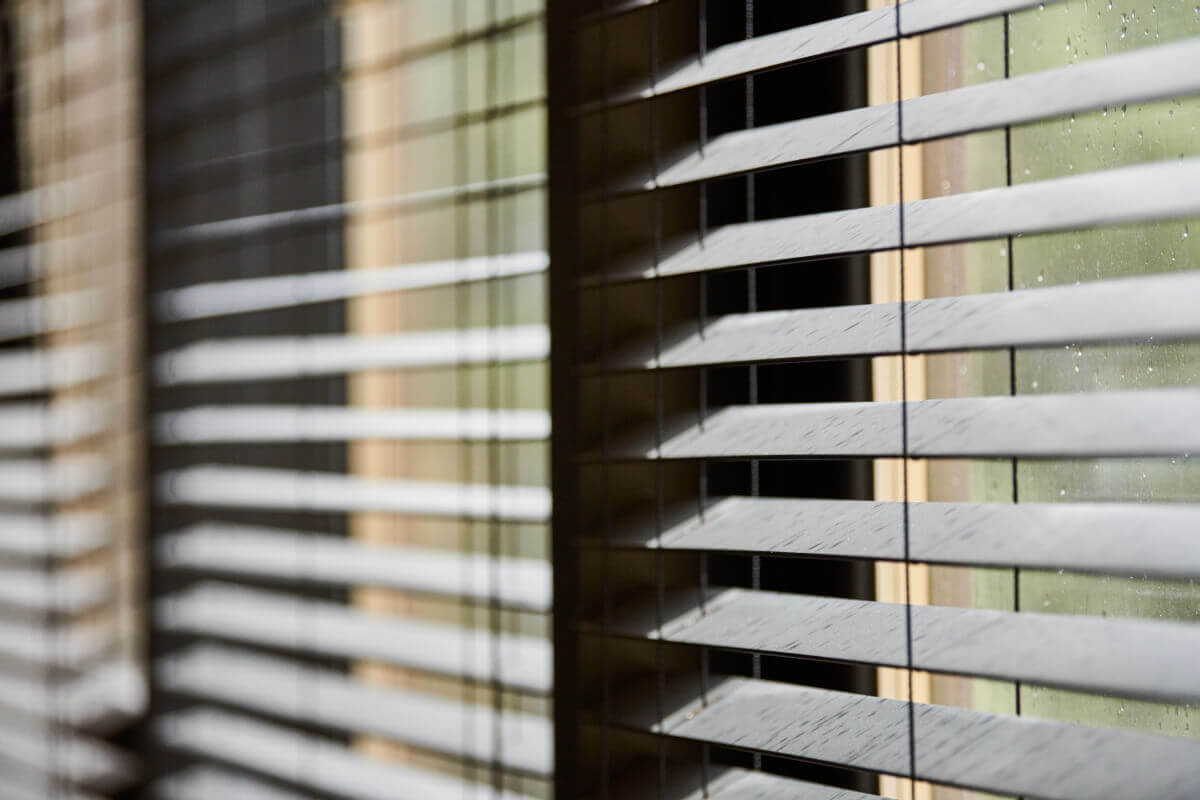
Made-to-measure wooden louvred blinds are well worth the price when they are intended to last for years outdoors and maintain smooth adjustment of shade and privacy without jamming. The cost stems mainly from the stable material (KVH/BSH), the consistent geometry of the slats, the rotation mechanism, corrosion-resistant fittings and assembly tolerances, rather than from the wood itself. Durability is determined by the cross-sections and spacing of the slats, the working clearance on the shaft, the rigidity of the posts and beams, and the protection of the ends and surfaces with UV-filtered oils. The additional cost is justified when the louvre forms part of a terrace or pergola structure and features correctly designed anchoring, an appropriate distance from the floor, and maintenance limited to periodic inspections and the renewal of the finish.
Made-to-measure wooden blinds: when is it worth paying extra, and what do you actually get?
Made-to-measure wooden louvred blinds are worth the price when they are intended to last for years outdoors whilst effectively addressing privacy, shade and wind protection without any makeshift solutions. In practice, you’re not paying just for the slats themselves, but for durable materials, consistent slat geometry, a rotating mechanism and installation that won’t fall apart after the first winter. At Dąb Gaj Wood, we create such systems as part of a larger terrace, pergola or gazebo structure, so we immediately view them as part of the structure rather than mere decoration.
Most of the problems arise because customers compare photographs rather than technical details: the play in the axle, how the sash moves, the protection of the wood’s end face, and whether the whole thing has enough room to operate. If you want to see what well-designed ones look like customised movable wooden blinds, make sure the manufacturer also shows the fittings, the cross-sections of the slats and how they’re secured – not just a smart-looking front. It’s these elements that determine whether, after three seasons, you’ll still be turning the slats with a single finger, or whether you’ll be tugging at the panel because it’s swollen and catching.
What do made-to-measure wooden slatted blinds actually cost?
The most expensive aspect of made-to-measure wooden slatted blinds is what you cannot see at first glance: the stability of the material, the mechanics and the manufacturing tolerances. The wooden slat itself is the smallest piece of the jigsaw, because the price is determined by the time taken for precise machining, the choice of fittings, and whether the slat will maintain its shape when humidity levels change. In production, the difference between ‘looking good in a photo’ and ‘operating smoothly’ often comes down to a few millimetres of clearance within the frame and correctly selected spacers.
If the awning is part of a larger structure, the load-bearing capacity and rigidity of the posts and beams become important considerations. An 18×18 cm load-bearing post (typical in premium structures) provides a margin against wind loads and does not twist as easily as a 12×12 cm post, which is important when a heavy slatted sash is suspended from the post. The main beam and steel connectors must transfer the moments generated by the slat panel’s operation, whilst a galvanised anchor and a correctly constructed point foundation ensure that the entire structure does not ‘shift’ after the rainy season.
The cost also rises due to the finish, as external shutters do not allow for any cut-backs on protection. OSMO UV-Schutz-Öl is an oil containing UV filters, which slows down greying and reduces the degradation of lignin in sunlight, whilst OSMO Oil Extra provides deeper impregnation and a flexible layer within the fibre structure, rather than a brittle coating like varnish. A well-applied stain and oil treatment is not merely about ‘colour’, but about controlling water and UV exposure – which effectively extends the lifespan of the slats and frame.
What types of wood and cross-sections work well in blinds with movable slats?
Wood with predictable behaviour and good dimensional stability works best, as the movable slats must not become wedged when humidity levels change. KVH is solid structural timber, kiln-dried and joined using micro-finger joints, which offers greater consistency and a lower risk of warping than standard sawn timber. BSH GL24 SI is a laminated timber with a GL24 strength class which, thanks to the arrangement of the lamellae and the bonding process, has lower internal stresses and therefore retains its straightness for longer in frames and beams.
Scandinavian spruce is often used for slats because it is straight-grained, takes oil well and has a predictable grain pattern, but larch is also a sensible choice in areas more exposed to water. Larch is naturally more resinous and more resistant to the elements, but it needs to be properly dried and protected, as it can ‘move’ and crack at the ends if you skimp on sealing them. In practice, choosing a timber species involves striking a balance between stability, appearance and how often you’re prepared to refinish the surface.
The cross-section of the slats and their spacing are not merely a matter of aesthetics, but determine the shade and rigidity. The shade is determined by the angle of the slats and their width, whilst the rigidity is determined by their thickness and the way they are mounted on the shaft or in the guide rails. If the slats are too thin, they start to ‘flap’ in the wind and are more prone to warping; if they are packed too tightly, they trap water and dirt, and the rotation mechanism has to work harder.
What determines the durability of the mechanism, and do made-to-measure wooden slatted blinds require servicing?
Durability depends on the rotating mechanism and the alignment of the axis, as the wood can be refurbished, whilst poorly chosen fittings can ruin the whole system. Good blinds have a predictable operating clearance, protected friction points and corrosion-resistant fittings, as moisture from the terrace and condensation take their toll even under a canopy. If the manufacturer does not specify whether the steel components are galvanised or made of stainless steel, you may find water stains and a ‘seized’ mechanism at the end of the season.
In practice, maintenance boils down to an inspection after the first season and periodic refreshing of the coating, rather than constant repairs. After winter, check that the slat panel has not sagged at the hinges, that the fixing to the post remains vertical, and that the slats are not rubbing against the frame as a result of swelling. If the blind is fitted to a pergola or arbour, it is also worth inspecting the rafters and the main beam, as even minimal roof deflection (e.g. under snow) can alter the geometry of the opening and reveal incorrectly set clearances.
- The most common installation error is failing to leave a gap between the flooring and the floor or ground, which means the bottom edge catches reflected water and draws in moisture by capillary action. In such cases, even the best oil won’t help, as the problem is constant dampness, not UV rays.
- The most common mistake when buying timber is choosing a size that’s ‘just right’ without allowing for the timber’s expansion and contraction, because everything looks perfect in July. After autumn and winter, the timber’s moisture content changes, and a poorly designed frame clearance results in the timber becoming wedged and requiring sanding on site.
Maintenance needn’t be a hassle if it is tailored to the outdoor conditions right from the start. OSMO UV-Schutz-Öl is usually reapplied every 2–3 seasons on sides exposed to strong sunlight, whilst in sheltered areas this is often less frequent, as the oil does not flake like varnish and does not need to be stripped back to the bare wood. It is essential to wash and degrease the surface before applying the next coat, and to pay particular attention to the ends of the slats, as this is where water penetrates most quickly.
How to order made-to-measure wooden slatted blinds without overpaying or regretting your decision
It is best to order made-to-measure wooden louvred blinds only once the layout of the entire terrace area and the fixing method have been finalised, as this way you avoid paying for alterations and ‘rescuing’ the installation. In practice, you first measure the clear spans between the posts and check that they are plumb, then determine the direction in which the slats will operate in relation to the wind and access routes, and only then do you select the slat spacing and the rotation mechanism. If the louvres are to work in conjunction with a roof structure, it is worth agreeing straight away whether the roof will be made of polycarbonate, metal roof tiles, bituminous shingles or ceramic tiles, as the different weight and behaviour of the roof affect deflection and tolerances.
The formalities usually apply to the entire structure, rather than the blinds themselves, but it is worth checking this before you start. For larger garden structures, the surface area of the structure is important, as is whether you are building a freestanding structure or one attached to a building; this may require either a building notification or planning permission, depending on the specifications and local requirements. If you are fitting louvres to an existing pergola, it is also crucial to check whether the posts and point foundations have sufficient load-bearing capacity to withstand the additional wind load.
- Ask the manufacturer what the frame and load-bearing components are made of: KVH or BSH GL24 SI, and why they chose that material for your post spacing. A good answer will refer to stability, not just ‘attractive timber’.
- Ask for a description of the protective treatment: how many layers, which OSMO product (e.g. Oil Extra or UV-Schutz-Öl), and whether the ends and the areas beneath the fittings are treated. These are the factors which, in real-world use, determine whether, after two years, you’ll be touching up the finish or battling against deterioration.
If you want your blinds to genuinely enhance the comfort of your terrace, treat them as a structural element and order them as part of a proper installation, rather than as an ‘afterthought’ at the end. In a well-designed system, you have control over shade and privacy whilst still allowing for ventilation, so the space doesn’t become stuffy as it would with a fully enclosed structure. From the client’s perspective, the best test is to ask yourself whether, in three seasons’ time, you’ll still want the same standard of performance and appearance — if so, then Dąb Gaj Wood He creates such works precisely with that long-term perspective in mind, rather than for the immediate reaction.
Read also: How can you keep your wooden slatted blinds in good condition?
Frequently asked questions
How long does it take to make made-to-measure roller blinds?
Typically, it takes several weeks from the initial measurements and technical specifications to installation, as the price includes precision machining, tolerance adjustments and a finish suitable for outdoor conditions. The time required increases if the blinds form part of a larger terrace structure and need to be coordinated with the construction of posts, beams and the roof. The process is quickest when measurements are taken on a finished, levelled structure and no alterations are required on site.
How do you prepare the site for the installation of external blinds?
The most important thing is to ensure the posts are securely anchored and perfectly vertical, as even slight deviations can later cause the sash to rub and put undue strain on the slats. Leave a gap between the sash and the floor or ground to prevent the bottom edge from catching splashed water and drawing in moisture through capillary action. Before installation, it is also worth determining the direction in which the sashes open in relation to the wind and the traffic flow on the terrace.
Do KVH and BSH differ in practice when it comes to blinds?
Yes, because KVH is a stable, solid structural timber, whilst BSH (e.g. GL24) is laminated and generally maintains its straightness even better in load-bearing elements. In practice, BSH is more often chosen for beams and frames, where rigidity is important and there is a lower risk of twisting under the load of the sash and in the wind. The choice of material should be based on the column spacing, the weight of the sashes and how the entire structure is intended to function.
How often do you need to oil the moving slats on the outside?
In strong sunlight, the UV-filtered oil is usually reapplied every 2–3 seasons, whilst in sheltered areas this is often less frequent. Before applying the next coat, it is essential to wash and degrease the surface, as this determines the adhesion and an even finish. Always ensure that the front edges of the slats are protected, as this is where water penetrates most quickly and problems tend to arise first.
Is it possible to customise the dimensions, colour and direction of opening?
Yes, because the point of made-to-measure blinds is to adjust the light between the slats, account for the natural movement of the wood, and ensure the direction in which the slats operate is suited to the layout of the terrace. The colour is determined by the stain and oil finish, but it must be chosen to suit the level of sun exposure in order to minimise greying and uneven ageing. It is worth finalising this before production, as subsequent changes to dimensions or the opening direction usually require modifications to the fittings and frames.