


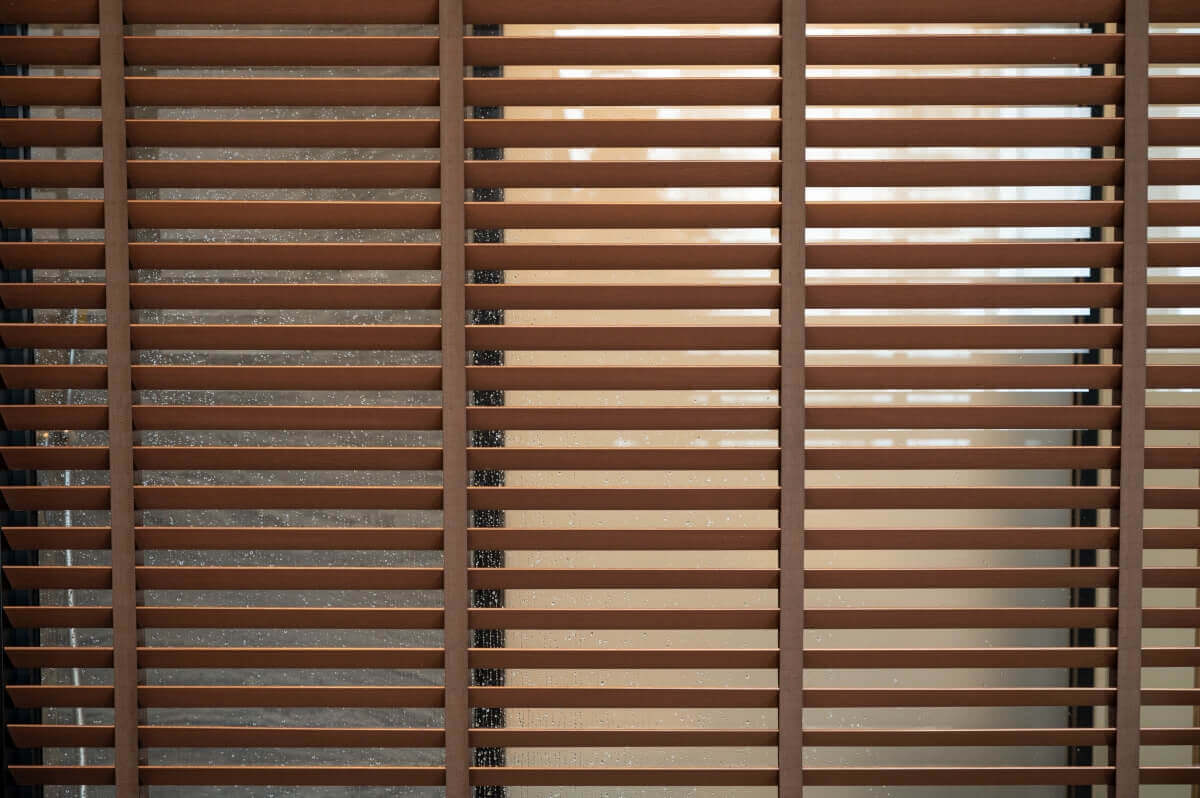
Wooden slatted blinds are kept in good condition by controlling moisture and UV exposure to the wood, as well as by regularly cleaning them and adjusting the mechanism that rotates the slats. The combination of damp, sunlight and friction in the fittings is what causes the most damage, exacerbated by a lack of a water drainage slope, slats set too tightly and poor ventilation. Durability is ensured by the use of stable timber (KVH/BSH in the structure), slat profiles with drip edges, and an OSMO oil finish, which should be renewed when the surface becomes dull and absorbs water more readily – typically every 2–3 seasons on south-facing exposures. Maintenance is carried out twice a year: cleaning with a soft brush, taking care not to direct the hose into the hinges; checking for play and tightening the fittings after winter; and adjusting the closing angle so that the slats do not slam shut or rub against the guides.
What causes the most damage to wooden slatted blinds, and how can this be prevented in practice?
Movable wooden blinds deteriorate most rapidly not simply due to rain, but because of the combination of moisture, UV light and friction within the mechanism that rotates the slats. When this is compounded by a lack of a water drainage slope, incorrectly positioned fixing points and an enclosure that is too airtight with no ventilation, the wood begins to warp and the fittings become loose.
At Dąb Gaj Wood, we design these systems so that the wood has somewhere to release moisture, and so that the mechanism isn’t forced to work against the grain, as it’s the first to ‘tell’ us that something’s wrong. If you’re planning to customised movable wooden blinds, make sure you ask straight away about the direction of water drainage, expansion joints and how the front edges of the slats are protected, as these are details that only become apparent after 2–3 seasons.
The most common installation error is fitting blinds under a cooker hood without a drip rail and without leaving a gap from the wall, which causes water to pool on the top edge and seep into the front of the wood. Another classic mistake is setting the slats ‘flush’ to achieve a fully blackout effect, only to be surprised when, at the first change in humidity, they start to rub against each other and the rotating mechanism becomes stiff. The third problem is the failure to check the anchors and steel fixings after the first winter, when the building structure and the timber ‘settle’ into their new geometry.
What type of wood and finish ensure that wooden slatted blinds do not warp over the course of a season?
The stability of the slats depends not so much on the timber species itself as on controlled moisture content and the grade of the material; this is why KVH and BSH GL24 SI are used for structural elements, whilst the profile of the slats is selected to prevent water from collecting on the edges. KVH is solid structural timber, kiln-dried and joined using micro-dowels, whilst BSH GL24 SI is a glued laminated timber with a GL24 strength class, which retains its geometry and has lower internal stresses than a solid beam.
In practice: it is advisable to support frames and posts (e.g. for larger terrace screens) on a stable structural material, whilst the slats themselves should be made from a profile with rounded edges and a distinct drip edge. Scandinavian spruce is predictable and lightweight, and takes well to oils and wood stains, whilst larch provides a harder surface and naturally better durability, but can ‘warp’ more if it is not properly dried and if the slat cross-section is too thick. That is why it is sometimes better to have a thinner slat with a good profile than a thick board that retains moisture for a long time.
The choice of finish depends on whether you want a coating that works in harmony with the wood, or a ‘shell’ like varnish. OSMO Oil Extra penetrates the grain and does not flake off in patches, so refurbishment after 2–3 years usually involves simply washing the surface and applying another coat, without stripping it back to bare wood. OSMO UV-Schutz-Öl works well in strong midday sun, as it slows down greying and stabilises the colour, whilst wood stain is a good option if you want a specific shade and an even finish across the entire terrace façade.
How should you clean and maintain the slat rotation mechanism without damaging the fittings?
The slat rotation mechanism will only last a long time if it is kept clean, maintains the correct assembly clearances and is not subjected to stress caused by warped timber. If the blind starts to move more heavily, do not simply ‘lubricate it blindly’; instead, first remove any dirt and check that the slats are not rubbing against the guides.
First, I clean the slats and the areas around the fittings with a soft brush and water mixed with a mild detergent, without using a pressure washer aimed at the bearings or joints. A pressure washer can force dirt and water into areas that need to remain dry, which can then lead to corrosion on bolts and steel fittings, even if they are galvanised. Once dry, I check that there is no axial play at the pivot points, that the bolts haven’t ‘come loose’ over the winter, and that the control strip isn’t twisted.
- Carry out seasonal maintenance twice a year: after winter and after the pollen season (spring/summer), as pollen from plants acts like an abrasive on the joints. Whilst you’re at it, adjust the angle at which the slats close so that they don’t slam against each other.
- If the manufacturer permits lubrication, use a product that is neutral to wood and oil-based finishes, rather than one that dissolves the oil or leaves a sticky film. A sticky film attracts dust, and after a month the mechanism will operate less smoothly than it did before servicing.
It’s also worth checking the ground fixings once a season: the galvanised anchor and steel connector are designed to bear wind loads, not to ‘hang’ on a single bolt. When the blinds form part of a larger terrace structure, I also check the main beam and any 18×18 cm support posts, as even the slightest twist in the frame can distort the alignment of the slats and force the mechanism to work harder.
When should you refinish an OSMO finish, and how can you do so without sanding down to the bare wood?
The OSMO oil finish should be renewed when the wood starts to lose its lustre and absorbs water more quickly, rather than only when it has turned grey and cracked. In practice, on south- and west-facing sides this is usually every 2–3 seasons, whilst on north-facing sides it is sometimes less frequent, as UV radiation has the greatest effect there.
Renovation without stripping works because the oil does not form a brittle crust like varnish, but instead penetrates the wood and can be ‘nourished’ with another layer. First, I clean the surface, removing any tarnish and greasy dirt, and then leave it to dry completely, as oil applied to damp wood will trap moisture inside. If there are localised rough patches or the fibres are standing on end after winter, a light sanding with fine-grit paper is sufficient, but only in those specific areas and without aggressively sanding the edge profile.
It is essential to protect the areas that absorb water most quickly: the front edges of the slats and the lower edges, where dew collects. There, I apply a thin but thorough coat of oil, as a thick layer will become sticky and trap dirt, whilst a thin layer will be absorbed well and won’t cause the mechanism to stick. If the blinds are close to the roof covering (polycarbonate, metal roof tiles, bitumen shingles or ceramic tiles), I also check for any persistent dripping from the roof edge, as this causes localised ‘burn-through’ of the coating and dark water stains.
What should you check after installation and after the first winter to ensure your blinds last for years?
Most durability issues don’t arise in the workshop, but after the first winter, which is why a post-season check is just as important as a proper installation. At that point, you should check the frame alignment, the operation of the slats across the full range of angles, and ensure that water is not pooling at any point in the system.
Once installed, I check three things: whether the expansion gaps between the slats are maintained, whether the guides and pivot points are aligned, and whether the fixings to the substrate are protected from moisture (spacer, washer, correct anchor). If the blinds form part of a larger terrace structure, it’s also worth asking about the formalities: with certain roof and side-wall configurations, restrictions such as building area limits may apply, and a building notification or planning permission may be required, and it’s better to sort this out before placing an order than after installation. In projects involving roofing supported by rafters and a main beam, I make sure that the roof pitch and flashings do not direct water onto the louvres, as even the best oil-based coating cannot withstand constant exposure to water.
After the first winter, I carry out a brief check-up: tightening the fittings, adjusting the limit stops, assessing the coating on the sides most exposed to the sun, and checking that nothing is rubbing when the shutters are in use in freezing conditions or after a thaw. If you want your awning to operate smoothly and look neat for years to come, do get in touch with Dąb Gaj Wood and ask about the maintenance schedule and the right OSMO oil for your decking.
Read also: Why are retractable wooden patio shutters better than awnings?
Frequently asked questions
How often should you service wooden blinds to prevent the mechanism from becoming stiff?
It is best to service the blinds twice a year: after winter and after the pollen season (spring/summer), as dust and dirt act like an abrasive on the joints. As part of the service, remove any dirt from the fittings, check for play and ensure the screws are tight, and adjust the closing angle of the slats so that they do not knock against each other. If the blind starts to feel stiff, first check whether the slats are rubbing against each other due to changes in humidity, rather than applying lubricant straight away.
Can I clean my wooden slatted blinds with a pressure washer?
It is best to avoid directing the pressure washer towards fittings, bearings and joints, as the water can force dirt into the mechanism and accelerate corrosion of steel components. It is safer to use a soft brush and water with a mild detergent, and only then dry everything thoroughly. If you do want to use a pressure washer, do so from a greater distance and never direct the jet at moving parts.
Which OSMO oil should I choose for the side of the terrace that gets a lot of sun, and how often should I reapply it?
OSMO UV-Schutz-Öl works well on south-facing surfaces, as it slows down greying and stabilises the colour of the wood. Renewal is usually required every 2–3 seasons, but the tell-tale signs are a loss of lustre and increased water absorption, rather than just noticeable greying. Before applying the next coat, wash the surface and allow it to dry completely so as not to trap moisture in the wood.
What should you do before installation to ensure the blinds drain properly and are well ventilated?
Ensure that the design allows for water to run off, includes drip edges and provides a gap from the wall, so that water does not pool on the upper edge or seep into the front of the slats. Ask for expansion joints and space for the wood to move to be left in place, as an installation that is too tight and lacks ventilation accelerates warping and friction within the mechanism. It is also worth ensuring that the fixings to the substrate are protected from moisture (using a spacer/washer and a suitable anchor), as this stabilises the geometry of the entire system.
What should you check after the first winter if the slats have started to rub or there is some play?
First, check the geometry of the frame, the guide rails and the pivot points, as even the slightest twist in the structure can cause the slats to become misaligned. Next, check that the fittings and fasteners are tightened and that the end stops are correctly adjusted, as after winter the building and the wood often ‘settle’ into a new position. If the rubbing persists, also check for any places where water is constantly dripping onto the shutters, as localised damp accelerates the movement of the wood and puts strain on the mechanism.