


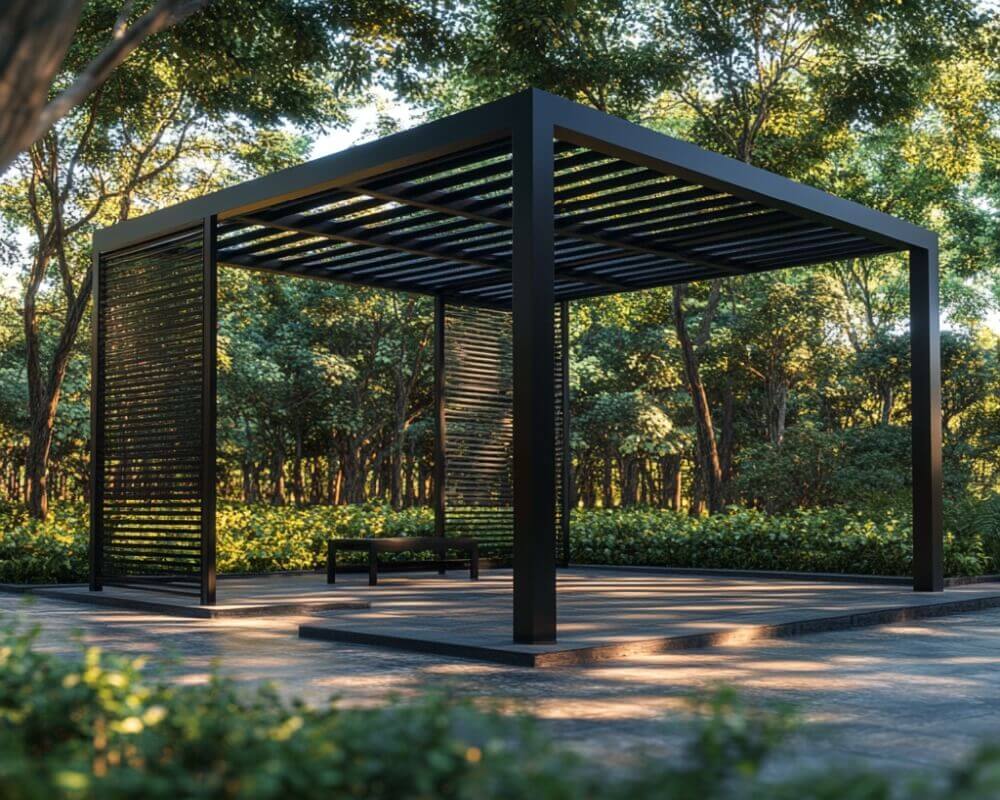
Retractable wooden patio blinds operate on a rigid frame and guides, which is why they withstand wind and rain more effectively than awnings, without the fabric flapping about. They transfer the load to the posts and the main beam, rather than to the fixing points and articulated arms. Their durability depends on the use of solid timber for the frames, correct installation clearances and ensuring the timber is protected from moisture at the anchor points.
Retractable wooden patio blinds – what are their practical benefits, and why are customers moving away from awnings?
Retractable wooden patio blinds provide stable, adjustable protection from the sun and wind without the flapping effect that, after two seasons, is the bane of many a awning. In practice, they function like an external patio blind: you can close, tilt or open the panel whenever you need to, rather than only when the weather permits.
Dąb Gaj Wood manufactures such systems using KVH structural timber (dried, planed and micro-finger-jointed) and GL24 SI BSH components (glued laminated timber of strength class GL24), as geometry and dimensional consistency are crucial for movable spans.
If you’d like to see what this solution looks like in a garden and what types of guides are available, take a look at movable wooden patio blinds – it is then easier to compare them with a traditional cassette awning.
Why do roller blinds with slats withstand wind and rain better than an awning?
Roller blinds with slats are better able to withstand wind and rain, as they operate on a rigid frame and guides, rather than on taut fabric and articulated arms. In an awning, the greatest stresses are borne by the wall fixings and the arms, and in gusts of wind, vibrations occur which, over time, loosen the fixings and cause holes to appear in the façade.
In wooden roller blinds, the loads are distributed differently: the section has a fixed geometry, and the forces are transmitted to the uprights and the main beam, rather than to a single bracket.
If the terrace structure is built on 18×18 cm load-bearing posts (this cross-section effectively stabilises the structure for typical spans), and the posts rest on galvanised anchors that isolate the timber from the damp ground, then wind is no longer a problem for the awning but becomes a normal structural load.
Rain is also easier to manage, as you can position the movable section as a side shelter and choose the roofing material to suit the conditions: multi-wall polycarbonate, metal roof tiles, bituminous shingles or ceramic roof tiles – each material has a different weight, acoustic properties and behaviour in the sun.
An awning usually ends up being rolled up when it rains anyway, because wet fabric quickly gets dirty, and if it’s rolled up before it’s dried, it can develop water stains and a musty smell.
What determines the durability of retractable wooden patio blinds: the wood, the guides or the wood preservative?
The durability of retractable wooden patio blinds depends on the stability of the wood, the quality of the slat guidance system, and whether the protective coating can be renewed without dismantling the system. It is usually not the slat itself that fails, but a component: an incorrectly selected installation clearance, a weak steel fastener, or a guide rail that has nowhere for water to drain and accumulates dirt.
KVH is ideal for frames and components that need to retain their dimensions, as it is kiln-dried and has a controlled moisture content, which minimises warping.
I use BSH GL24 SI (laminated timber) where the beam is longer, greater span, and I want to minimise seasonal work – laminated timber reduces stresses which, in a solid beam, can result in a crack after the first winter.
Impregnation is only effective if the wood is properly prepared and has somewhere to dry, rather than lying in a puddle.
In practice, the OSMO oil system works best: OSMO Oil Extra as a base coat (the oil penetrates the fibres and does not form a brittle coating like varnish) and OSMO UV-Schutz-Öl for areas exposed to strong sunlight, as UV rays cause the colour to fade and the surface to dry out most quickly.
After 2–3 seasons, refurbishment involves washing the surface and applying a coat of oil to high-wear areas, without sanding down to the bare wood – and that is the difference you’ll notice in the running costs, rather than on the day of handover.
The most common installation error is failing to protect the timber from moisture and failing to ensure a slope on horizontal elements. A galvanised anchor and a gap from the floor solve 80% problems with water seepage, whilst a small drip edge on the underside of the board does the rest, as the water does not run back along the underside into the centre of the span.
When does an awning make sense, and when do retractable wooden patio blinds come out on top in terms of practicality?
An awning is a good choice when you need quick shade over a window or a small patio and don’t plan to enclose the sides or ensure privacy. Retractable wooden patio blinds are the best choice when you want your terrace to be a second living room: you want to shield yourself from the wind, neighbours, low sun and passing showers, whilst also ensuring a cohesive look with the wooden structure.
In practice, the biggest difference lies in the way the area is shaded: an awning mainly provides shade from above, whilst roller blinds operate vertically and diagonally, so you can create shade exactly where the sun is actually shining under the canopy.
On a west-facing side, when the sun is low, an awning often does little more than trap hot air beneath the fabric, whilst a movable slatted screen can block out the glare without turning the room into a dark cave.
The second issue is the acoustics and the feel of the structure: the fabric moves, flutters and transmits vibrations, whilst the spring or crank mechanism doesn’t cope well with sudden jerks. A wooden panel on runners is heavier and smoother-running, so even in bad weather, the terrace doesn’t become a place from which you’ll want to flee back indoors.
- If the terrace is exposed to the wind, ask how the panels can be locked in their extreme positions and whether the guides have stops – without these, even the best timber will rattle in gusts of wind.
- If privacy is important to you, check the spacing between the slats and whether the panels can be angled – it’s a detail that determines whether you see only greenery, or your neighbour with a cup of coffee.
What do the design and installation involve, and what should you ask the manufacturer before placing an order?
The design and installation process begins by measuring the clearance between the posts and checking where the load can realistically be transferred, as the roller blind is a moving component that does not tolerate any curvature.
First, the structural layout is determined (posts, main beam, rafters if any); then the infill and the arrangement of the spans are selected; and only finally are the finishing touches applied, such as oil treatments, and details such as coverings and drainage.
At the construction stage, it is worth knowing whether the terrace is supported by a finished concrete slab or by point foundations, as this determines the choice of anchors and steel fixings. With heavier roofing (clay tiles, solid boarding), the cross-sections are calculated differently than with lightweight polycarbonate, and in Poland, snow loads can make a greater difference than wind alone.
The administrative requirements usually boil down to whether you are exceeding the permitted building footprint and whether the structure is freestanding or attached to a building, as this affects whether you need to submit a building notification or apply for planning permission.
In practice, I ask the client whether the terrace is already included in the house plans and what its dimensions are, as sometimes a slight change to the width of a span makes it possible to follow a simpler administrative procedure.
Before placing an order, ask the manufacturer four specific questions, as these will immediately help you distinguish between solutions that look good in photos and those that will last for years: what material are the frames made of (KVH or solid timber), are the load-bearing beams made from BSH GL24 SI for larger spans, how is the timber separated from the floor (galvanised anchor and spacer), and what does the maintenance of the OSMO coating involve after 2–3 seasons?
If you want a terrace that can withstand the sun, the wind and everyday use, make sure you get these details right from the start, and leave the construction and installation to a team of professionals – at Dąb Gaj Wood That is precisely what the whole process is based on.
Read also: How can you protect the movable boards on a pergola from damp?
Frequently asked questions
How long does it take to manufacture and fit wooden roller blinds on the patio?
The lead time depends on the number of spans, the type of guides, and whether the entire terrace structure is being built from scratch or whether only the roller shutters are being fitted to an existing structure. The on-site installation itself usually takes 1–2 days, provided the posts and beams are ready and the ground is level. A quote with a delivery date can be provided most reliably once the span between the posts has been measured and the load-bearing points have been checked.
How do you prepare the terrace and the ground for roller blinds on guide rails?
The most important thing is to ensure that loads are transferred stably to the posts and beam, and to maintain straight vertical and horizontal lines, as the moving component does not tolerate any curvature. The timber should be protected from moisture by a galvanised anchor and a spacer from the floor, and the horizontal elements must have a slope to prevent water from pooling on them. If the decking is on a concrete slab or point foundations, the choice of anchors and steel fixings must be adapted to the specific sub-base.
Can wooden blinds be made to measure and in a custom colour?
Yes, such systems are typically designed to accommodate the specific light conditions between the posts and to suit the intended operation of the panel within the guides. In practice, the colour is chosen to match the oil finish, as this determines the shade and affects any subsequent restoration. When placing an order, it is worth establishing straight away whether privacy or ventilation is the priority, as the spacing between the slats and the ability to adjust their angle alter the final effect.
How often does it need to be oiled, and what does restoration involve without dismantling?
In practice, after 2–3 seasons, the areas that are most heavily used and exposed to the sun are refreshed, as it is UV radiation that causes the colour to fade and the surface to dry out the quickest. Renovation involves washing the surface and applying a new coat of oil, without stripping it back to bare wood, provided an oil-based system was used previously. This is one of the advantages over an awning, as there is no issue with damp fabric, water marks or odours when the decking is rolled up.
Do you need to apply for planning permission or a licence for wooden roller blinds on the patio?
This usually determines whether the structure as a whole is treated as a terrace extension, whether you are exceeding the permitted building area, and whether the structure is free-standing or attached to the building. In practice, the same roller shutters may form part of a design that falls within the scope of a simple notification, or may require planning permission if they alter the building’s parameters. The safest approach is to check this at the stage of taking measurements and preparing the house’s documentation, before finalising the layout of the posts and the width of the spans.