


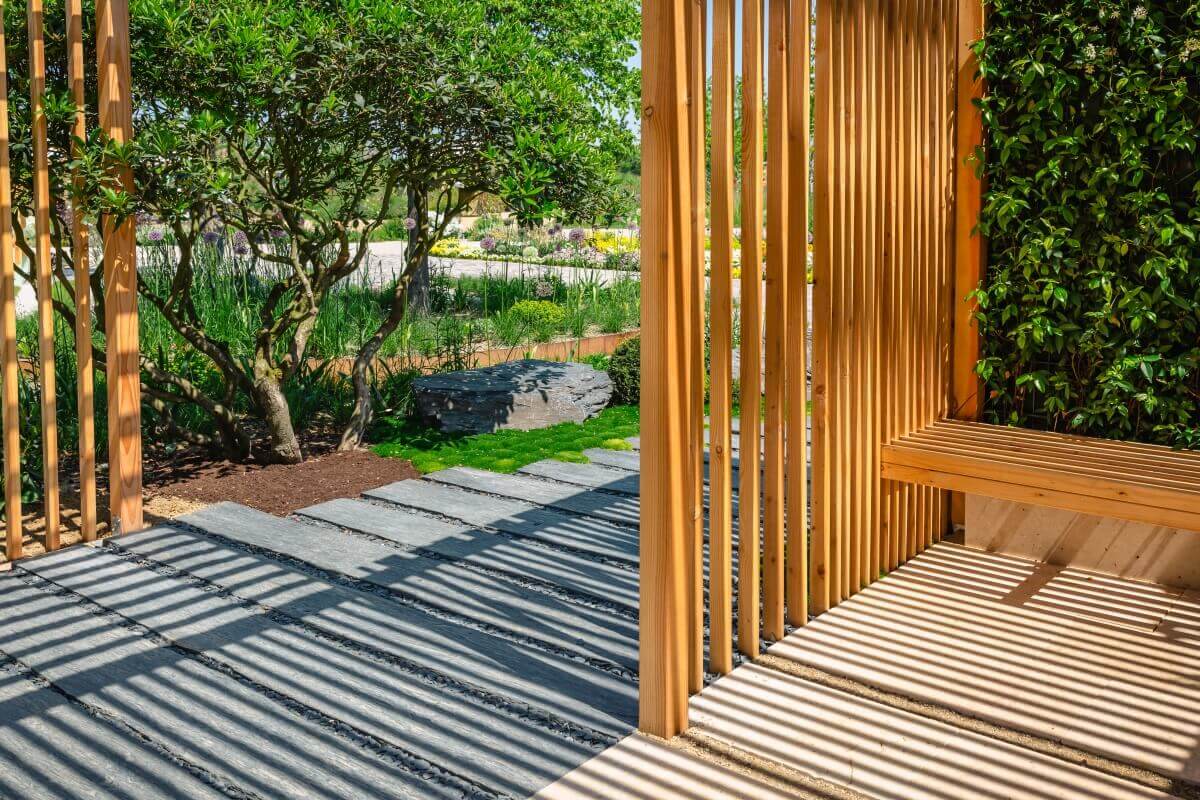
The movable slats for the pergola are protected against moisture by thoroughly oiling all absorbent areas (particularly the ends, milled edges and holes for the pins) and by creating a profile that quickly cuts off and drains away water. It is crucial to use a stable material (KVH or BSH GL24) and to allow for installation clearances, so that swelling after rain does not wear away the coating in the guide rails. Moisture penetrates most rapidly at points of friction and joints, where the coating is subject to mechanical wear; therefore, edges should be chamfered, and fittings sockets should be smooth and protected prior to installation.
Why do the slats on a pergola absorb moisture, and what does this mean in practical terms for installation?
The movable slats on a pergola absorb moisture mainly at the edges, at the joints and where they move as part of the rotating mechanism, as this is where the coating wears away most quickly and the wood is left exposed, allowing water to be drawn in.
In practice, this means that the slats swell, the mechanism has to work harder, and after a season or two, black deposits (colonies of surface fungi) and localised cracks begin to appear.
In Dąb Gaj Wood, most of the complaints I’ve seen in the industry aren’t due to poor-quality timber, but to inadequate protection of friction zones and assembly clearances that are too tight, leaving no room for the material to move naturally.
The most reliable protection starts with treating movable boards for pergolas as a mechanical component, rather than simply as ordinary cladding boards: the impregnation is important, but so too are the profile’s geometry, the radii at the edges and the way water drains from the slats.
If the board has sharp edges and a flat surface where water collects, even the best oil will last for a shorter time, as the moisture has time to penetrate the fibres. On the other hand, a well-chamfered or rounded edge and a minimal slope on the profile do the job just as well as an extra coat of OSMO.
What type of wood and what grade should I use for the movable boards on a pergola to prevent them from swelling after rain?
Slats made from structural timber with a stable moisture content and predictable behaviour cause the fewest problems with swelling and warping, rather than random planks from a sawmill. KVH is a four-sided planed, kiln-dried structural timber with micro-finger joints, which maintains its specifications and offers dimensional stability, meaning the mechanism does not lose any play after a season.
BSH GL24 SI is a laminated timber in strength class GL24, which retains its geometry even better in longer sections, as the lamination reduces the internal stresses responsible for twisting.
Scandinavian spruce is the most common base timber for KVH/BSH, as it has uniform growth, dries well and absorbs oils in a predictable manner; however, the species alone is not enough without the right technology.
Larch can be tempting because it is more durable, but the moving slats can release resin and cause staining, and when there are significant fluctuations in humidity, micro-cracks tend to form in the heartwood, which shortens the service life of the coating in the friction zone.
If a customer naturally wants more durable timber, it is usually better to opt for the correct lamella profile, effective water drainage and an oil treatment system, rather than relying on larch to protect itself.
Durability is also determined by where the timber is used within the overall pergola structure: the 18×18 cm load-bearing post and the main beam made of BSH GL24 SI stabilise the structure, so the slats are not subjected to any additional twisting caused by deflection.
A rafter or purlin that sags under the weight of snow can cause the frame to warp slightly, at which point the moving boards begin to rub against the guides and wear away the coating down to the bare wood. This is the point at which moisture enters, not through rain, but through mechanical wear and tear at critical points.
How should I prepare the movable boards for the pergola before oiling them, to prevent moisture from getting into the ends and the milled edges?
The most effective way to prevent moisture ingress is to prepare the surface and seal the ends, as the end grain of the wood soaks up water like a straw. In the workshop, I always start by finishing the piece: planing, sanding and, crucially, rounding off the edges, because a sharp edge won’t hold the coating and the first bit of rain will leave an open wound there.
It is equally important that all the cut-outs for the axles, the sockets for the fasteners and the points of contact with the fittings are smooth and free of grease, as moisture tends to linger longest in these recesses.
The most common mistake on building sites is to oil only the visible parts, whilst leaving the raw ends and the insides of the sockets untreated, as these aren’t visible during the final inspection. If a board has a hole for a dowel or screw and untreated wood inside, water drawn in by capillary action causes a localised blister, and the coating then peels away in a radial pattern.
In the case of moving parts, this accelerates wear and tear, as every rotation acts like sandpaper on the edge of the coating.
In practice, it is best to carry out the preparation in two stages: first, protect the edges and recesses, and only then treat the entire surface. OSMO Oil Extra (a deep-penetrating oil for external timber) penetrates the grain and does not form a brittle crust like varnish, so when working with slats, renovation is simpler and does not require stripping back to the bare wood along the entire length.
On parts exposed to strong sunlight, I apply OSMO UV-Schutz-Öl, as the UV filter helps prevent greying and a loss of water repellency – effects that become particularly noticeable on the upper surfaces of the slats after 2–3 seasons.
What aspect of the assembly and the mechanism’s design makes the biggest difference in terms of protection against moisture?
The biggest difference is made by the installation clearances, water drainage and the choice of fittings, because moisture in a louvre pergola most often causes problems in areas of friction and where water pools. If a sliding slat is too tight between the guides, it swells by a fraction of a millimetre after rain, begins to jam, and the mechanism wears away the coating precisely where the wood should be most protected.
The second point is geometry: a lamella positioned flat collects water, whilst a lamella with a slight slope and a drip edge (an edge that cuts off the drop) drains it more quickly.
It is also worth ensuring that the steel components are suitable for outdoor conditions, as rust can spoil the appearance and accelerate the deterioration of the coating at the point of contact. A galvanised anchor and a steel fastener with a suitable coating (or stainless steel in critical areas) help to minimise water seepage, which penetrates the wood and causes discolouration that is difficult to remove without sanding.
If the pergola is situated on a terrace where water runs off the tiles or composite decking, it is worth raising the operating range of the slats and ensuring proper ventilation, as moisture from below can be just as damaging as rain.
The roofing above the slat area is also important, even in the case of a pergola with movable slats: polycarbonate or metal roof tiles above the main beam can help prevent water from flooding the mechanism, but at the same time they may increase condensation when there are significant temperature differences.
Bituminous shingles and ceramic tiles allow the roof to ‘breathe’ more effectively, but they require a proper substructure and ventilation gaps to prevent moisture from becoming trapped in pockets. In practice, the choice of details depends on the location: different solutions are required for a garden exposed to wind and rain, and different ones for a terrace built against the wall of a house.
How often should I carry out maintenance, and what should I check at the end of the season to prevent the movable boards from developing mould?
Maintenance is recommended every 1–3 seasons, but the actual interval depends on exposure to the sun and rain, and on how intensively the slat mechanism is used.
If the pergola faces south and the slats are rotated frequently, the first re-treatment with OSMO UV-Schutz-Öl is usually advisable after 12–18 months, as UV exposure and friction at the edges reduce the water-repellent properties more quickly than on fixed boards. If the pergola is sheltered and the slats are used less frequently, it is perfectly possible to maintain good protection by reapplying the oil approximately every 2–3 years, without the need for aggressive sanding.
- Check the edges of the slats and the areas around the pin holes: if you can see any dullness or a dry texture, this is a sign that water is starting to seep in via capillary action and you’ll need to apply oil to specific areas.
- Check the areas where the fittings and runners come into contact: dark streaks and scuff marks are not dirt, but the worn-away protective coating, which should be reapplied before the wood swells and starts to jam the mechanism.
- Check the drainage and any water pooling: if, after rain, water remains on the slats for more than a dozen or so minutes, the problem is usually the alignment rather than the oil itself.
When refreshing the finish, it is essential to clean the surface without damaging the wood with chemicals or sanding it down completely. In practice, it is sufficient to wash the surface, lightly sand any worn areas and apply a thin layer of oil following the grain, as the OSMO system works within the wood itself rather than as a thick topcoat.
If any surface mould has appeared, it should be gently removed and the protective coating restored, as surface mould is most often the result of prolonged dampness and a lack of ventilation, rather than a disease affecting the structural timber.
Building regulations can also indirectly affect durability, as they dictate the building’s dimensions and the method of foundation: for larger building areas, a building notification or planning permission may be required, and this often means a different type of foundation and different anchoring details.
Well-constructed point foundations and correctly selected anchors limit the rise of damp in the area around the posts, which stabilises the entire frame and reduces the risk of the slats rubbing against each other.
If you want to choose a security solution tailored to a specific location and intended use, the easiest way is to go through the design and details with a contractor such as Dąb Gaj Wood, because the devil is in the details – in the areas of friction, water ingress and drainage – rather than in the name of the water-repellent treatment itself.
Read also: Do louvre pergolas allow you to control the amount of light?
Frequently asked questions
How much play should be left for the slats to move, so that they don’t jam the mechanism after it has rained?
The clearances are selected to suit the profile, the length of the slats and the installation location, but in practice it is not worth adjusting them to a tight fit, even if everything runs smoothly during a dry run. Wood can swell by fractions of a millimetre after rainfall, and that is enough for it to start wearing away the coating on the guides. The safest approach is to agree on the clearance with the contractor at the design stage and test the mechanism’s operation after the first rainfall, before considering the installation complete.
Do you need to oil the faces and the holes for the pins if they’re not visible anyway?
Yes, because the edges and the insides of the holes absorb water the quickest, and that is where swelling and delamination of the finish usually begin. The raw wood in the socket beneath the pin acts like a capillary, drawing in moisture and causing localised blistering. Protect these areas as a first step, and only then oil the entire surface of the slats.
Which fittings and fasteners are best suited to damp conditions in a slatted pergola?
Outdoors, use fittings and fasteners with a suitable anti-corrosion coating, and in critical areas, opt for stainless steel to minimise rust and water stains. Corrosion caused by contact with wood can accelerate the degradation of the coating and leave discolouration that is difficult to remove without sanding. It is also worth ensuring that metal components do not form pockets where water can collect near the mechanism.
How often should you re-oil the movable boards of a pergola, and how can you tell when it’s time to do so?
Refreshing is usually carried out every 1–3 seasons, and in strong sunlight or where the slats are frequently adjusted, this is typically done after 12–18 months. Signs that a refresh is needed include the surfaces becoming dull, the wood drying out around the slat openings, and scuff marks where the slats come into contact with the guides. Don’t wait until the wood starts to swell and jam the mechanism, as renovation will then be more difficult and time-consuming.
What can be done to prevent the slats from developing black deposits and surface mould?
It is crucial to ensure that water drains quickly from the slat profiles and that there are no areas where water pools, as mould tends to form where moisture lingers for the longest. Ensure the correct geometry (slope, drip edges) and ventilation, particularly where the pergola is situated above a terrace, where moisture reflects off the surface. At the end of the season, check for wear in high-friction areas and top up the oil in these specific spots before moisture begins to penetrate the untreated wood.