


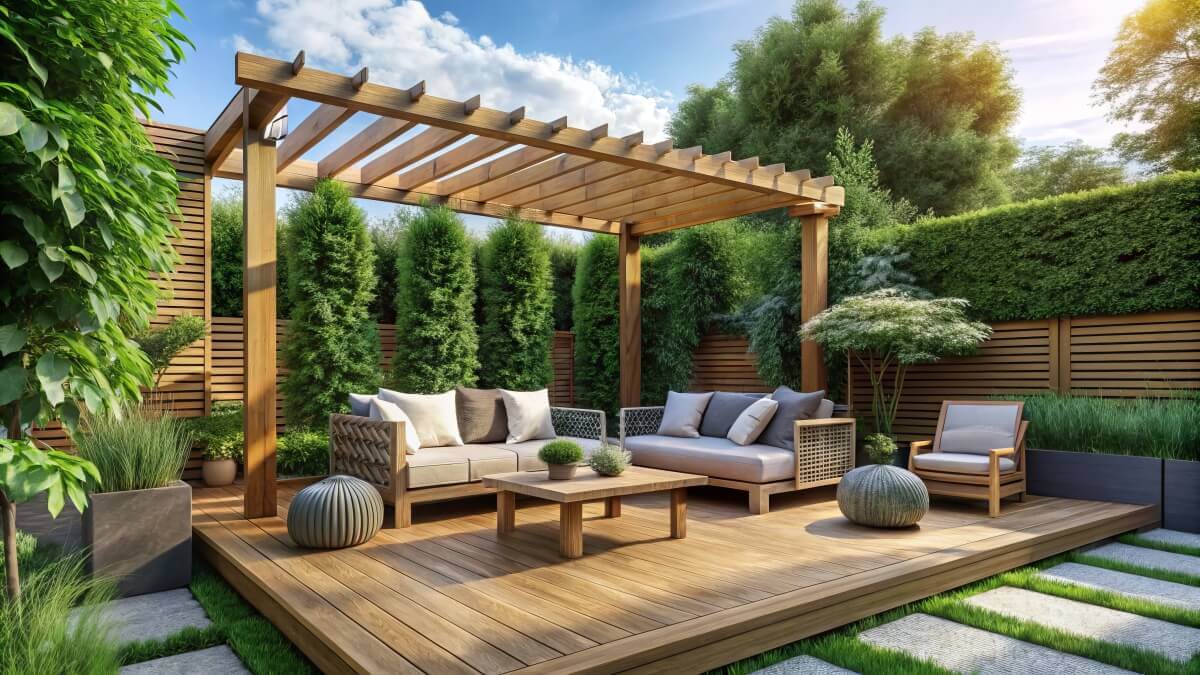
Wooden pergolas in shades of honey brown, warm grey (weathered) and deep graphite or dark brown complement greenery best. Honey-coloured finishes brighten up the area beneath the canopy and bring out the light-coloured foliage; grey tones bring order to the composition when paired with modern architecture; whilst graphite provides a strong contrast to hedges and climbing plants, even in winter. The final shade is not a RAL colour, but depends on the type and grade of timber (KVH or BSH GL24 SI) and the oiling system; therefore, the same stain may appear different on different cross-sections.
How do you choose a colour so that wooden pergolas look natural against the greenery?
Colours that do not compete with the plants but instead provide a backdrop for them work best: natural honey-coloured browns, warm greys or deep graphite. In practice, wooden pergolas situated next to the lawn and flowerbeds look their best when the colour of the wood matches the façade and offers a balanced level of contrast to the foliage.
At Dąb Gaj Wood, we select the colour right from the design stage, because the finish determines not only the aesthetics but also how the product holds up after 2–3 seasons. If you’d like to see how we put this into practice in real-world designs, take a look at the section wooden pergolas and notice how the different shades look in the shade and in full sunlight.
The colour of the wood is not determined by a RAL colour code, but by a combination of factors: the species (e.g. Scandinavian spruce, larch), the grade of the timber (KVH or BSH GL24 SI) and the oil treatment system.
BSH GL24 SI is a laminated timber with a GL24 strength class, which retains its shape and twists less, so the colour ages more evenly on the main beams and rafters; KVH is solid structural timber, kiln-dried and planed, which also provides stability, but in long sections it can be more susceptible to fibre movement.
These are details that only become apparent over time, once the sun and rain have beaten down on the structure dozens of times.
Which shades of wood complement the greenery in the garden best?
The three safest choices are: natural honey, weathered-style greys, and dark browns and graphite, as each creates a different contrast with greenery. A honey shade adds warmth to flowerbeds and complements plants with light-coloured foliage; grey brings a sense of calm to a composition set against modern architecture; and graphite provides a strong frame for greenery and looks great in winter.
Honey and golden browns are easiest to achieve on Scandinavian spruce and KVH, as the wood has an even grain and takes the oil well. In practice, on a terrace roof, this colour allows light to filter through to the pergola, so the relaxation area does not appear visually heavy, even if you add terrace blinds or dense climbing plants.
One drawback is that UV light causes the colour to change more quickly towards a warmer patina, so it is worth planning for UV protection as part of the oil-based system right from the start.
Shades of grey (ranging from light oak-ash to steel grey) look most natural alongside ornamental grasses, lavender and cool-toned greenery, but they require a smooth surface and an even application, as any scuff marks are clearly visible.
On the BSH GL24 SI, the grey colour appears more consistent on large cross-sections, as the main beam and the 18×18 cm support post are subjected to less stress, so micro-cracks – which trap dirt and create darker streaks – do not form. If the garden is heavily shaded, I tend to choose a warmer shade of grey, as a cool shade can make the space look dull.
Dark browns and graphite shades look most striking when paired with vibrant greenery (hedges, boxwood, ivy), but they are technically the most demanding. Dark colours absorb more heat, so cladding and beams are subjected to greater temperature fluctuations; this accelerates the natural movement of the timber and can cause joints to open up if the structure is too light or poorly anchored.
With dark finishes, I pay particular attention to the details: expansion joints, drip edges and ensuring that the steel fixings are properly protected (galvanised or stainless steel), because every water mark is visible against a dark background.
Why does the colour of a wooden pergola depend on the grade of timber and the OSMO system?
The colour will remain even only if the timber is dimensionally stable and has a protective finish that works with it, rather than against it. That is why BSH GL24 SI and KVH, as well as OSMO oils, are better suited to external structures, as they minimise typical problems such as cracking of the finish, flaking and an uneven patina.
The BSH GL24 SI is a laminated timber product in which the lamellae are glued together in such a way as to reduce stress and torsion, which is important for long spans and large cross-sections.
When you have 18×18 cm posts and a main beam that supports the roof load (e.g. polycarbonate, metal roof tiles, ceramic tiles or bitumen shingles), the stability of the material ensures that the joints and edges do not come apart after the winter. And if the edges aren’t under stress, the colour on the corners won’t wear off as quickly either.
KVH (structural solid timber, kiln-dried, planed and joined with micro-dowels) is ideal for rafters, purlins and components where consistency and straightness are required. With transparent finishes, KVH is more forgiving because it has a consistent grain pattern, but with dark, opaque finishes and in full sunlight, you still need to ensure proper ventilation and keep the timber dry.
The most common fault that becomes apparent after the season is a lack of clearance from the ground or an incorrectly chosen galvanised anchor, which causes the base of the post to become waterlogged and turn black due to damp, rather than from the dye.
OSMO Oil Extra and OSMO UV-Schutz-Öl are oils that penetrate the structure of the wood fibres and do not form a hard crust like traditional varnish, making renovation simpler and more predictable. In practice, after 2–3 years, you don’t strip the entire coating down to the bare wood; instead, you clean the surface, matt it in places and apply a new coat, and the colour returns without flaking at the joints.
This is important when it comes to greenery in the garden, as pollen, plant sap and microalgae penetrate cracked coatings more easily, whilst properly maintained oil provides a clean, even surface.
What spoils the visual effect amongst the plants, and how can this be avoided during installation?
More often than not, it is water stains, uneven ageing and dirty edges that spoil the look, rather than a poorly chosen shade. This can be avoided if, right from the design stage, you ensure proper drainage, correct fixing and sensible exposure of the wood to the sun.
Leaks usually originate from two places: the roof and the fittings.
With multi-wall polycarbonate roofing, the slope and the correct sealing of the chambers are important, as condensation can drip directly onto the joists and leave dark marks; with bituminous shingles and metal roof tiles, the flashings and drip edges are crucial to ensure that water runs off the edges rather than running down the timber.
If you fit a gutter, make sure you choose one that won’t overflow during heavy rain, as a single season of overflow can discolour even a well-oiled surface.
Uneven ageing is usually down to light: one side of the pergola is exposed to full UV, whilst the other is in the shade of trees or the house wall. Under such conditions, I choose a colour so that the patina is acceptable (shades of grey and medium browns are the safest options), and I also apply OSMO UV-Schutz-Öl to the most exposed parts, as the UV filter slows down colour change.
If a customer wants a very light shade in strong sunlight, I tell them straight away: without regular maintenance every 2–3 seasons, the lightness won’t be maintained evenly.
Dirty edges and black spots on the posts are almost always caused by damp rising from the ground and timber that has been set too low. An 18×18 cm load-bearing post should rest on a suitable anchor (usually made of hot-dip galvanised steel) and be raised off the ground, whilst the point foundation must be constructed in such a way that water does not pool at the base.
When a pergola stands amongst greenery, watering and damp grass take their toll, so the details of the foundations are just as important as the colour of the wood stain.
When should you choose a light colour and when a dark colour for a wooden pergola next to the terrace, and what does the maintenance involve between seasons?
Choose a light colour if you want to make your terrace appear larger and brighten up the area under the canopy, and a dark colour if you’re looking for a strong backdrop for greenery and to ensure it blends in with modern window frames. In both cases, colour durability depends on UV exposure, the quality of the oil finish, and whether the structure has properly designed drainage and ventilation features.
With light-coloured finishes, the biggest enemy is UV light and localised sun damage, which is why I plan to make maintenance a regular part of the upkeep: washing, checking the edges and applying a layer of oil where water and the sun’s rays have the greatest effect.
With dark-coloured finishes, heat build-up occurs, so I take particular care to ensure that the main beam and rafters are made of stable timber (BSH GL24 SI or carefully selected KVH), and that the steel fasteners do not act as wedges within the timber. These aren’t issues that become apparent on the day of installation, but only after the first cycle: summer–heavy rain–winter.
If the pergola has a fixed roof (e.g. metal roof tiles, ceramic roof tiles, bituminous shingles) or adjustable features such as a system of movable slats or a patio awning with a rotating mechanism, I also choose the colour to match the shade cast by that roof.
The more shade there is, the darker a shade you can get away with without creating a ‘cave-like’ effect, but this increases the importance of external lighting (min. IP44) and light reflection from the floor. In practice, it’s the combination of the floor, façade, greenery and the colour of the wood that makes all the difference, rather than the colour chart alone.
Bureaucratic formalities do not usually prevent you from choosing a colour, but they do affect whether the pergola is classed as a light structure or a building requiring planning permission. For larger structures, a building notification or planning permission may be required, depending on the building’s footprint and local regulations, so it’s worth checking this before placing an order to avoid having to change the design partway through.
If you want to choose a shade that complements your greenery whilst also being confident about the timber, fixing and after-sales service, the best approach is to go through everything with the contractor from start to finish — this will help Dąb Gaj Wood.
Read also: Why are wooden decking boards ideal for sunny days?
Frequently asked questions
Can I choose the colour of the pergola to match the façade and the greenery before the structure is built?
Yes, it’s best to decide on the shade at the design stage, as the colour depends on the type of wood, the grade of the material (KVH/BSH) and the oiling system. In practice, it’s worth comparing samples at the installation site, both in the shade and in full sun, as wood looks different under various conditions. This makes it easier to choose a shade that contrasts with the greenery and avoid any surprises after the first season.
What colour of pergola will be the easiest to keep clean from pollen and plant sap?
Grey and medium brown shades are the safest choices, as they show uneven ageing, dust and minor dirt from the garden the least. Very light finishes reveal localised darkening more quickly, whilst very dark finishes highlight water stains and marks more prominently. If the pergola is situated close to lush greenery and frequent watering, it is also crucial to ensure the timber is properly protected from moisture around the posts.
How often do you need to touch up the colour with oil on a pergola that’s in full sun?
Maintenance is usually scheduled every 2–3 seasons, although the parts most exposed to UV light may need refreshing sooner. Usually, there is no need to strip the finish down to the bare wood; simply wash the surface, sand it down in places and apply a coat of oil. Regular maintenance is particularly important for light shades, as they lose their even colour more quickly without it.
Won’t dark graphite or dark brown get too hot and fade?
Dark finishes heat up more, so the timber is subjected to greater temperature fluctuations and warps more quickly if the structure is too light or poorly detailed. This can be managed by using stable timber (e.g. BSH GL24 SI), correct anchoring, expansion joints and well-designed drainage. It is also important to bear in mind that water stains are more visible against a dark background, so the gutter and drip mouldings have a real impact on the appearance.
Will the same shade look the same on KVH and BSH GL24 SI?
Not always, as the final result depends on the wood grain, absorbency and how the material behaves over time. BSH GL24 SI usually ages more evenly on large cross-sections, as it warps less and is less prone to micro-cracks, which subsequently trap dirt. If you want a very even colour on your posts and beams, it’s worth selecting an oiling system and shade to suit the specific construction timber.