


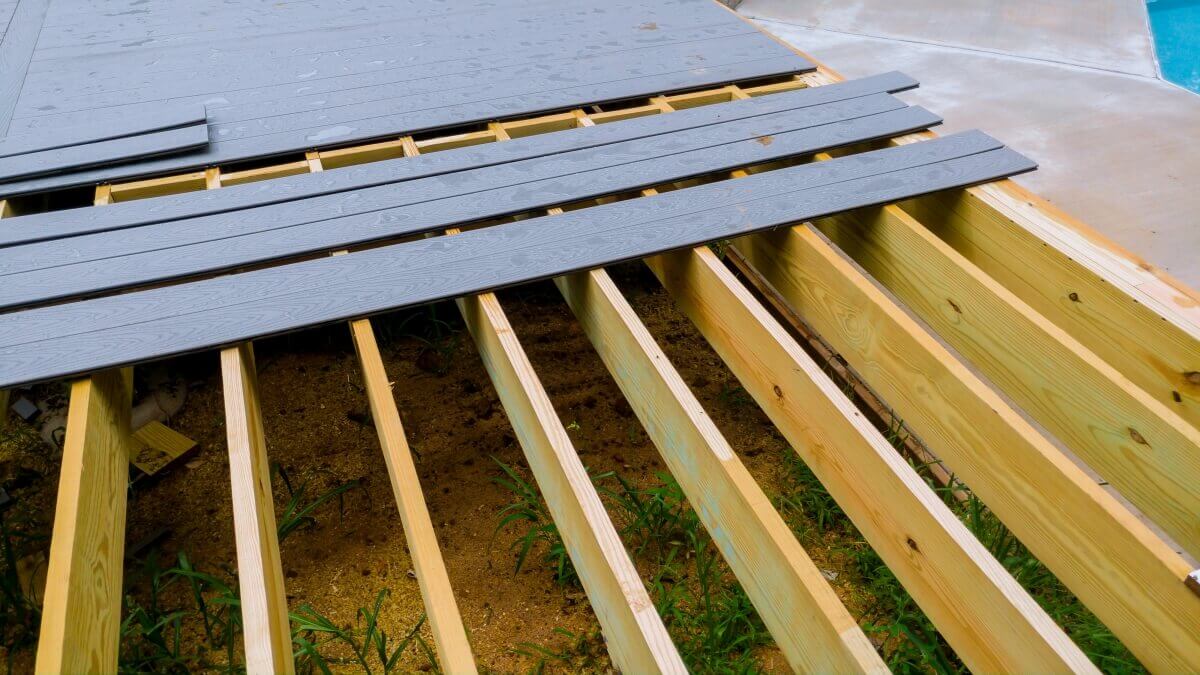
Wooden decking is ideal for sunny days, as wood has low thermal conductivity and heats up more gradually than tiles, stone or dark composite materials, making it more comfortable to walk on barefoot. With proper expansion gaps and ventilation from below, the wood behaves predictably through cycles of heat and rain and releases moisture more quickly, without creating a ‘steam room’ effect beneath the decking. Stability in full sun depends on the selection and moisture content of the material (e.g. kiln-dried Scandinavian spruce, well-graded larch) and on the use of suitable, corrosion-resistant fixings. Protection against UV radiation and greying is provided by oils containing UV filters, whilst the choice of a light or medium pigment limits surface overheating and helps maintain performance characteristics throughout the season.
What makes wooden decking panels the best choice in full sun?
Wooden decking is ideal for sunny days, as it doesn’t heat up as ‘aggressively’ as stone or dark composite materials, and provides a more natural, consistent level of comfort underfoot. In practice, I notice this straight away on site: in the afternoon, when the terrace faces south or west, the wood releases heat more gently, and the surface doesn’t get uncomfortably hot when walking barefoot. At Dąb Gaj Wood, we design and install decking and timber structures so that this comfort doesn’t end after just one season, but remains just as good even after three years of sun and rain.
Decking panels perform well in hot weather partly because, when laid correctly, the timber behaves predictably and has a way to release moisture after a storm, rather than ‘cooking’ underneath. If you’d like to see how we select the profile, thickness and finish, take a look at our range: wood panels for a terrace – it’s the finer details of the workmanship that make all the difference in July, not just the colour in the catalogue. In the following sections, I’ll break the topic down into its constituent parts: wood species, OSMO finish, installation and common mistakes that only become apparent after the first heatwaves.
Why is wood on a decking more comfortable underfoot than tiles or composite materials?
Wood feels more pleasant in the sun because it has a lower thermal conductivity than ceramics and concrete, so it ‘releases’ the accumulated heat to the skin more slowly. In practice, this means that even when the boards are warm, there is none of that burning sensation that often occurs on porcelain tiles or dark decking boards. Furthermore, the texture of the wood (brushed or grooved) distributes contact more evenly, whilst the micro-pores help to wick away a film of water more quickly after a sudden downpour.
Comfort in hot weather also depends on colour and finish: light-coloured wood stains and oils with UV filters reflect some of the radiation and stabilise the colour. From installation experience: a south-facing terrace in a dark colour will always be warmer, regardless of the material, so it’s better to plan for shade straight away (a pergola, a louvre, or a polycarbonate canopy) rather than counting on the ‘material to sort it out’. If the terrace is part of a larger garden structure, it’s worth integrating it into a single system: 18×18 cm support posts for the roof, a main beam and rafters selected to suit the span and snow load, rather than ‘by eye’.
The most common mistake that spoils comfort in the sun is laying the boards or panels too tightly together, without leaving expansion gaps. As the wood goes through its cycle of night-time damp and daytime heating, it changes in width only slightly; but when there is no clearance, it starts to bulge or wedge itself against the screws, creating sharp edges. A well-built decking area has a controlled gap, stable support and corrosion-resistant fixings, because hot metal in contact with moisture is a sure-fire way to get black water stains.
What type of wood and what grade should I choose for wooden decking when the terrace is in full sun?
In full sun, wooden decking boards made from timber with a stable structure and predictable shrinkage perform best, rather than random boards of mixed quality. Scandinavian spruce is a good choice when it is carefully selected, kiln-dried and properly treated with oil, as it has an even grain pattern and fewer ‘surprises’ during seasonal changes. Larch offers naturally higher resistance to weather conditions thanks to its resins, but requires a careful approach to selection – if poorly graded, it can crack more easily in the sun.
In structures accompanying a terrace (e.g. roofing, pergolas, screening walls), the timber grade is even more important than in the decking itself. KVH is solid structural timber, kiln-dried and micro-finger-jointed, which offers consistent dimensions and less shrinkage than standard sawn timber – ideal for rafters or transoms. BSH GL24 SI is a laminated timber with a GL24 strength class, which maintains its geometry over long spans and is less prone to twisting; in practice, a main beam made from BSH does not ‘settle’ after two seasons when subjected to the weight of, for example, polycarbonate, metal roof tiles or even clay roof tiles.
If the decking is integrated into a gazebo, carport or pergola, ask the manufacturer not only about the timber grade, but also about the moisture content of the timber at the time of installation. Material that is too wet after the first of July can release moisture rapidly, resulting in cracks at the edges and gaps widening. In well-prepared timber, the difference after three seasons is visible to the naked eye: fewer splinters, less warping and a more stable colour.
How do OSMO oils and wood stains protect a decking from UV rays and overheating in July?
OSMO oils and stains protect your decking from the sun because they penetrate the wood fibres rather than forming a hard coating that cracks due to the wood’s natural movement and UV rays. OSMO Oil Extra forms a flexible layer within the wood, meaning the surface does not flake like varnish, and refurbishment after 2–3 seasons usually involves simply washing the surface and applying another coat. OSMO UV-Schutz-Öl is an oil containing UV filters, which slows down greying and stabilises the colour on terraces exposed to strong sunlight, particularly on façade walls and cladding panels, where UV rays strike at an angle for many hours.
The choice of pigment also has a real impact in hot weather: the more pigment in the oil, the better the UV protection, but also the greater the change in colour compared to untreated wood. On terraces where people walk barefoot, I avoid extremely dark colours, as any material will feel warmer in such cases; it is better to choose a medium or light shade and provide structural shade (a pergola or a terrace awning with a rotating mechanism). Blinds with adjustable slats allow you to set the angle to block out the harsh sun whilst still letting a breeze through – this is often more important for comfort than the temperature of the decking boards themselves.
A common maintenance mistake is oiling ‘in direct sunlight’ on a hot terrace. The oil then dries too quickly, does not have time to be absorbed evenly and can leave streaks that are only visible when the sun is low and shining at an angle. The second mistake is applying too thick a layer – the wood should be saturated, not drenched, because excess oil attracts dust and becomes slippery after the first rain.
- If the terrace is used every day in the summer, I check the condition of the oil coating after the first season and usually give the high-traffic areas a light touch-up. These are the areas where UV exposure and wear and tear occur simultaneously.
- If the panels are partially covered (e.g. by bitumen shingles or polycarbonate), I adjust the maintenance routine accordingly: the exposed section ages more quickly, so it makes no sense to stick to a single schedule for the entire surface.
What determines the durability of decking installations in the sun and after summer storms?
Three factors determine the durability of the installation: ventilation from below, the right fixings and stable support, as the terrace is subjected to alternating exposure to sun and water. If there is no gap or drainage beneath the decking, moisture accumulates against the joists; then, when the heat arrives, it turns into a ‘steam room’ – this is the quickest route to warping and accelerated wear of the surface finish. That is why spacing, the slope away from the building and clear water drainage are so important – rather than just a neat joint between the boards.
Fasteners must be selected to suit an outdoor structure, not to match the living room furniture. Stainless steel screws or appropriately protected screws, galvanised anchors for the posts and steel fasteners at the structural joints eliminate the problem of black water stains and joints coming loose following cycles of heating and cooling. If the terrace is connected to a pergola or a canopy, I install point foundations and level the posts (e.g. 18×18 cm) in such a way that water does not ‘back up’ under the structure, as even the best wood preservative will be ineffective in that case.
Formally, a terrace does not usually require planning permission, but when a roof or other structure is added, regulations regarding the built-up area and the classification of the structure come into play. A building notification is often sufficient for simple roofing structures, whereas for larger structures or those integrated with the building, a planning permission may be required – this is something worth checking before placing an order, to avoid having to revise the design partway through. From a practical point of view, this ‘paperwork’ detail can save the installation deadline, as the structure cannot be sensibly broken down into stages if the foundations and anchors are to be aligned from the outset.
If you want a decking that’s comfortable in July and doesn’t become slippery or collect splinters after a storm, the key lies in the combination of good-quality timber, proper installation and sensible maintenance with oil – rather than relying on a single ‘magic’ parameter from the product description. In practice, the best approach is to discuss your sun exposure, the slope of the ground and whether you’re planning to provide shade with a pergola or blinds, as this dictates both the layout of the decking and the choice of finish. If you want to go through this process – from design to installation – without any guesswork on site, get in touch with Dąb Gaj Wood and we’ll come up with a solution that will look great in full sunlight for seasons to come.
Read also: Are wooden panels for pergolas suitable for seasonal roofing?
Frequently asked questions
Will wooden decking panels get very hot in direct sunlight?
Wood generally heats up more gradually than tiles, stone or dark composite materials, so walking barefoot on it is more comfortable. The colour of the oil or wood stain is also important: light and medium shades usually help to reduce the sensation of excessive heat. If the terrace faces south, it’s worth planning for shade from a pergola or terrace awnings straight away, as this is the quickest way to improve comfort in hot weather.
How do you prepare the sub-base for decking so that water doesn’t collect?
It is essential to ensure there is a slope away from the building and space for water to drain away, so that water does not pool under the panels or against the joists. Ventilation clearance from below and spacers are also required, as without these, a ‘steam room’ effect occurs after a storm and the timber warps more quickly. Before installation, it is worth preparing stable, level support points and checking that nothing is blocking the flow of water towards the garden.
How often should you oil a south-facing decking, and when should you do it?
On terraces exposed to strong sunlight, an inspection is usually carried out after the first season, followed by a refresh every 2–3 seasons, particularly in walkways. It is best to apply the oil at a moderate temperature and out of direct sunlight, as the oil dries too quickly on hot wood and may leave streaks. Before applying the next coat, it is worth washing the decking and allowing it to dry thoroughly.
Which type of timber should you choose for a terrace in full sun: spruce, larch, or perhaps something else?
In full sun, stability and the choice of timber are key: Scandinavian spruce works well if it is kiln-dried and properly treated with oil, whilst larch is often more durable but, if poorly graded, can crack more easily. It’s worth asking about the timber’s moisture content during installation, as material that’s too damp can crack rapidly and cause gaps to widen after the first heatwave. If the decking forms part of a larger structure, structural elements such as joists or beams are best supported by KVH/BSH structural timber, as this maintains a more stable geometry.
How long does it take to install wooden decking, and what should I prepare before the team arrives?
Installation time depends on the area and the complexity of the project, but for a typical terrace it usually takes 1–3 working days, provided the sub-base is ready. Before the team arrives, it is worth ensuring access to the work site and a power supply, as well as preparing the supports and checking the slope, so that the water drainage does not need to be adjusted once the decking boards have been laid. If you’re planning a pergola, a louvred awning or a canopy, it’s best to finalise this in advance, as it affects the layout of the joists, anchors and the positioning of the posts.