


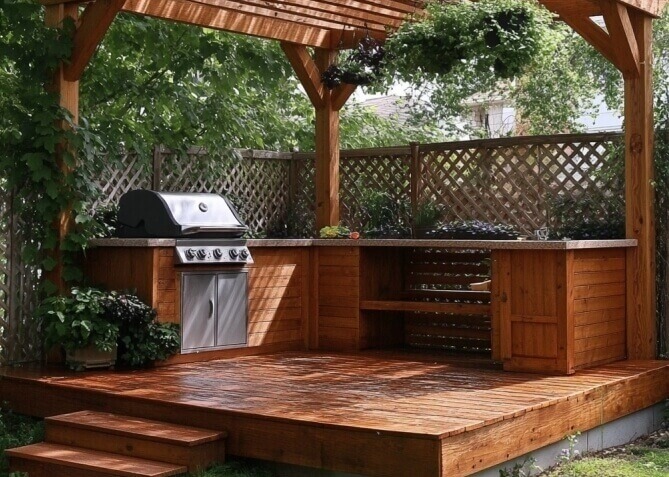
Wooden garden gazebos do not require frequent maintenance, provided they are properly designed, set on footings and protected with a suitable coating. In the Polish climate, it is standard practice to reapply oil or wood stain every 2–5 years, whilst horizontal elements and those most exposed to the sun usually require treatment every 1–2 years. The ageing process is accelerated by a small overhang, the absence of drip mouldings and slopes, contact between the wood and the ground, and dark finishes in full sun, as these intensify the wetting–drying cycle and UV degradation.
Do wooden garden sheds need to be renewed every season and what does this depend on?
Wooden garden gazebos do not necessarily require frequent maintenance if they are well designed, made from the right type of timber and properly treated. In practice, this usually means refreshing the finish every few years, rather than undertaking a tedious annual refurbishment.
The difference between a gazebo that still looks very good after 8–10 years and one that starts to turn grey and develop cracks after just 2–3 seasons is mainly down to the quality of the workmanship and how it is used.
If you plan to wooden garden sheds for years to come, it's worth understanding from the outset what maintenance really means: not just painting, but checking joints, water drainage and woodworking. A well-made gazebo is supposed to work naturally, and you are only supposed to refresh it periodically, rather than salvaging it after design mistakes.
How often do wooden garden sheds need maintenance in the Polish climate?
Wooden garden gazebos usually need their finish refreshed every 2–5 years, depending on their exposure to sun and rain, as well as the type of wood preservative and finish used. In practice, the parts most exposed to the sun and rain (e.g. west- and south-facing sides, and areas around the guttering and eaves) are repainted more frequently than those in the shade.
A definition worth adopting: gazebo maintenance is the inspection of the structure and the maintenance of a protective coating so that the wood does not absorb water or degrade from UV. Structural timber itself is durable, but without a coating it catches discolouration, micro-cracks and loses aesthetics more quickly.
Indicatively, it looks like this:
- A covered gazebo with a wide eave, sheltered from the wind: repaint every 4–5 years, as rain is less likely to beat against the posts and panelling.
- A gazebo that is heavily exposed to the sun and the elements: it should be refinished every 2–3 years, as UV rays and water wear away the protective layer more quickly.
- Horizontal elements (e.g. benches, tops, handrails), if any: often every 1-2 years, as water stands for longer and mechanically wipes away faster.
The lifespan of a well-built gazebo, with normal care, quietly exceeds 15-25 years. Structures made of decent glued laminated timber or KVH, with proper foundation and water protection, can stand for much longer, and maintenance comes down to scheduled refreshing of the coating, not structural repairs.
What makes wooden garden sheds age faster and require more frequent maintenance?
Wooden garden gazebos require more frequent maintenance when water is able to pool and the sun beats down directly on the wood for most of the day. The biggest enemy is not the rain itself, but the repeated cycle of getting wet, drying out and exposure to UV radiation.
To be clear: outdoor wood will always work and change colour over time. Maintenance makes the difference as to whether this change is controlled and aesthetically pleasing or whether it turns into a peeling coating, deep cracks and localised bluishness.
The most common causes of premature wear:
- Roof eaves too small: when the eaves are, for example, 10-15 cm, rain easily soaks the posts and infill; with eaves of 30-50 cm, the wood is realistically better protected.
- Contact between the timber and the ground or splashing water: if a post stands on the ground, moisture enters from below; the correct solution is to use base plates and ensure the timber is raised off the ground.
- No dips or drips: horizontal edges without drainage cause water to stand and penetrate the wood and the coating to let go faster.
- Too dark a colour in full sunlight: dark stains and oils heat up more strongly, so the coating ages more quickly and needs to be refreshed more often.
The quality of the material itself is also important. Good-quality structural timber (e.g. BSH GL24 or KVH) is more dimensionally stable, which reduces movement at joints and cracking in critical areas.
In gazebos with typical dimensions of 3×3 m, 3×4 m or 4×4 m, 12×12 cm posts are commonly used, but for heavier roofs and larger spans, it is safer to opt for more substantial cross-sections, e.g. 18×18 cm, as the structure sways less in the wind and the protective coating is not subjected to such severe stress at the joints.
How do you maintain wooden garden sheds so that work is infrequent and predictable?
Wooden garden sheds are preserved most simply when you act regularly and lightly: washing, inspecting and refreshing with a thin coat before the coating starts to peel. This approach reduces working time and costs, because you don't get into aggressive sanding or peeling off old layers.
Maintenance should be seen as a cycle: a post-winter check-up, cleaning, minor repairs and only then, if necessary, refreshing the finish. If the arbour is finished with oils or wood stains, you can usually refresh it without a full renovation, as you do not create a thick, impermeable film as with some film-forming paints.
A proven workflow (under realistic garden conditions):
1) Spring cleaning: water, soft brush, possibly a dedicated wood product. Use the pressure washer with care and distance, as it can lift the fibres and make the wood more absorbent.
2) Check critical areas: the lower parts of the posts, around joints, the soffit/eaves, areas near the gutters and bolted covers. You’re not so much looking for cosmetic cracks as for points where water can seep in.
3) Slight tarnishing and refreshing: if the surface is dull and dry and the colour has clearly faded, a light sanding and one coat of oil/glaze is usually sufficient. When the coating is still tight, sometimes cleaning alone is sufficient.
4) Repairing details instead of painting the whole thing: sealing vulnerable areas, improving the dripline, replacing a single cover board - this is often a better investment than adding more layers to the whole gazebo.
As for the costs: repainting a gazebo measuring approx. 3×3 m, if done yourself, usually costs several hundred zlotys for materials (depending on the product and the number of coats). The most expensive scenarios are when someone waits too long and has to strip back to bare wood over large areas.
Do premium wooden garden sheds really require less maintenance and how much does it cost to start?
Premium wooden garden sheds tend to require less maintenance because they have better structural protection against water and more stable timber, and this translates into slower wear and tear of coatings. It's not that premium doesn't need to be moved, it's just that the work is less frequent and more predictable.
The definition of premium in practical workmanship is: stable structural timber (e.g. KVH or BSH GL24), sensible cross-sections, correct footing, a roof with appropriate eaves and a well-chosen impregnation and finishing system. When these elements are fine-tuned, the gazebo does not catch moisture at critical points and the coating does not flake off.
The approximate costs of realising a wooden gazebo in Poland are very dependent on the dimensions, roof and side buildings, but for the sake of order a fork can be assumed:
- Extensive implementations with add-ons (slatted buildings, wooden roller shutters, moving board systems, lighting): they can go above and beyond, but in return you get function and comfort for most of the year.
In practice, the customer saves the most not by doing no maintenance at all, but by not having to deal with flaking paint, blue stain at ground level or joints splitting apart every year. If you want to approach this sensibly, design your arbour so that the timber is structurally protected and maintenance is a simple task carried out every few seasons.
This is exactly how we carry out our projects in Dąb Gaj Woodbecause a gazebo is meant to be enjoyed in the garden, not to generate a list of chores for every May.
Read also: How do wooden garden gazebos affect garden design?
Frequently asked questions
How long does it take to maintain a gazebo if you look after it on an ongoing basis?
With a regular approach, you usually close the subject in 1-2 days: washing and inspection one day, and refreshing the coating the next (with a break to dry). The most time is taken up by wrapping and securing the surround and getting to the hard-to-reach areas at the eaves and joints. If you don't wait until peeling, light work without peeling off old layers is usually sufficient.
Is it necessary to sand the entire gazebo before oiling/glazing?
Not always, because with a coating that is not flaking and is only tarnished, washing and localised tarnishing is often enough. Full sanding makes sense when the old layer is coming off in patches or the wood is heavily greyed and you want to even out the colour. The earlier you refresh with a thin coat, the less often you return to heavy preparation.
How do I prepare the ground so that the columns do not catch moisture from the ground?
It is essential to keep the timber off the ground – that is, to mount it on feet or spikes and to ensure it is correctly set on stable ground. In practice, it is also worth ensuring that water does not splash onto the posts (e.g. by placing a ring of gravel around the edge) and that the ground slopes away from the arbour. If the timber stands directly on the ground, maintenance will be required more frequently, as moisture seeps in from below regardless of the protective coating.
KVH or BSH (GL24) - which to choose for less frequent maintenance?
Both KVH and BSH are more stable than typical solid wood, so tend to reduce joint work and the risk of cracking in critical areas. BSH (glulam) tends to be even more predictable with larger sections and spans, helping to keep the sheathing in better condition. The choice is worth tailoring to the project: for larger gazebos and heavier roofs, it is more likely to pay to go with glulam.
How do you know when a coating needs refreshing, not just washing?
If, after washing, the wood darkens quickly from water and you can see that it absorbs moisture, this is a sign that the protection has weakened. A second signal is a pronounced leaching and dullness on the south/west sides and at the eaves and gutters. When peeling appears, it is not worth delaying, because later on, instead of one coat, a bigger renovation is done.