


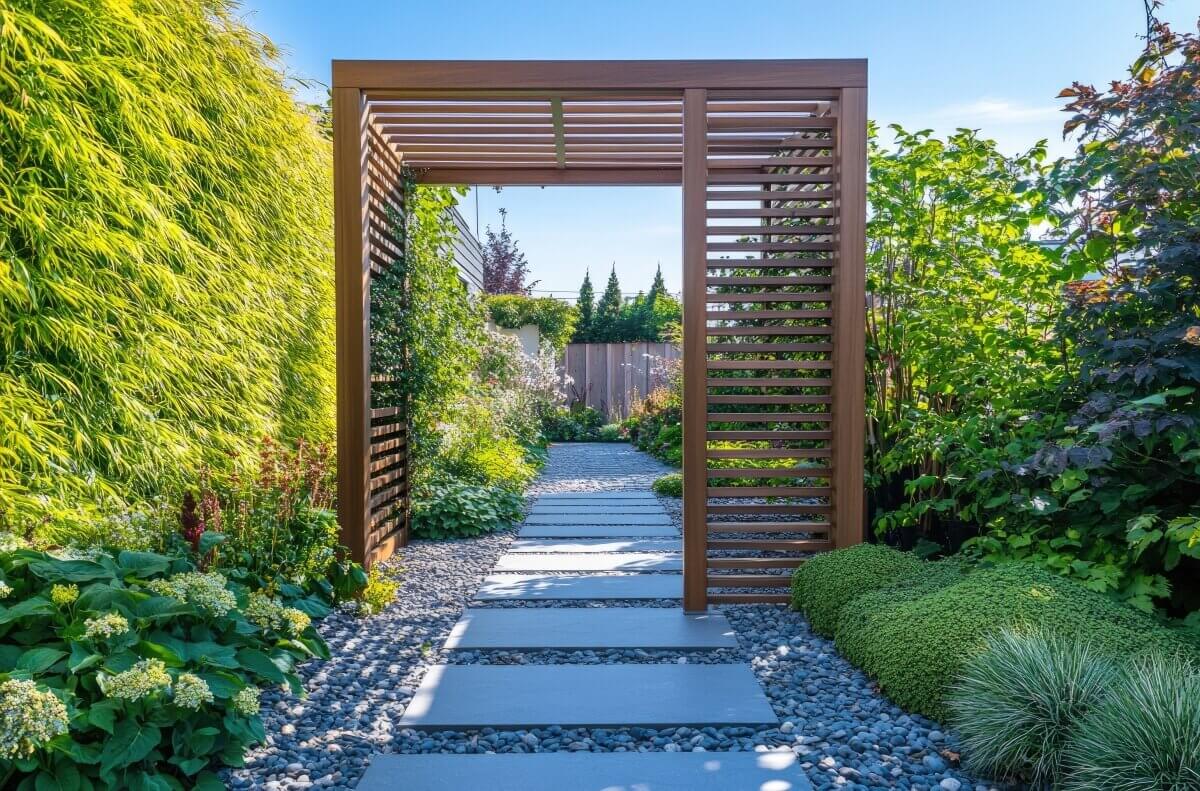
Wooden pergolas for balconies enhance privacy by providing a permanent screen on the side, front or corner, limiting the view from neighbouring balconies and the street. This effect is achieved by selecting the height of the screen (usually 180–220 cm from the floor) and the arrangement of the slats, which blocks sightlines whilst still allowing light to pass through. In practice, an openwork spacing of 20–35 mm with slats of 40–60 mm proves effective, whilst for balconies facing a busy street, a spacing of 15–30 mm with slats of 60–90 mm is more commonly used.
Do wooden pergolas on balconies really enhance privacy and comfort?
Wooden pergolas for balconies can effectively shield you from your neighbours’ gaze, whilst also tidying up the space and providing pleasant shade. In practice, they act as an elegant screen that can be adapted to the layout of the balustrade, the direction the balcony faces and how you actually use it.
Dąb Gaj Wood designs these structures with everyday use in mind: to ensure they are stable, attractive and easy to assemble.
If you’re considering a ready-made solution, take a look at what they’re like wooden balcony pergolas and which designs work best in multi-family housing. Wooden pergolas for balconies can be designed as a lightweight frame with side panels, a more enclosed L-shaped structure, or a module with adjustable slats that you can adjust depending on the time of day.
How do wooden pergolas on a balcony act as a screen from neighbours and the street?
Wooden pergolas on balconies enhance privacy by creating a physical barrier to the view: from the side, front or above, depending on the design. The best effect is achieved by combining openwork slats (which let light through) with sections of more solid construction where they are closest to neighbours’ windows. In practice, even a screen measuring 180–220 cm in height from the balcony floor level is enough to block out most unwanted glances.
The definition is simple: a balcony pergola is a lightweight frame structure to which shading elements – such as vertical slats, horizontal slats, panels or adjustable blinds – are attached. If privacy is important to you, we usually take one of two approaches:
- Side screen (the most common type) – blocks the view from the neighbouring balcony; a typical module is 90–140 cm wide and 180–220 cm high.
- Front or corner screen – useful for balconies facing the street; the openwork version retains a sense of lightness, whilst the denser version creates an effect almost like a windbreak.
To prevent the balcony from becoming a dark, enclosed space, a gap is left between the slats. In everyday use, a gap of 20–35 mm works well with slats 40–60 mm wide: it’s harder for people outside to see in, whilst you still get plenty of light and a draught.
Wooden pergolas for balconies can also be complemented with climbing plants, but the structure itself should provide privacy straight away, without having to wait two seasons for the greenery to grow.
What dimensions and slat arrangement in wooden balcony pergolas provide the best privacy?
The best privacy in wooden balcony pergolas is achieved by arranging the slats at an angle or in a dense, openwork pattern, tailored to the direction from which people most often look in. If a neighbour on the side is the issue, a side screen approximately 200 cm high is essential; if it is the street and passers-by, the front area from seat level upwards is more important.
In practice, the project begins with two measurements: the height of the balustrade and the distance to the nearest vantage point (the window or balcony opposite).
Definition of slat arrangement: this refers to the way in which the boards or slats are arranged (vertically, horizontally, diagonally) and their spacing, which determines how much can be seen from an angle. For privacy, the following are most commonly used:
Vertically: slats positioned vertically extend the screen and are effective against neighbours on either side. Typical slat dimensions are 30×50 mm or 40×60 mm, whilst the supporting frame is usually 60×60 mm or 80×80 mm, depending on the span and method of fixing.
Horizontally: horizontal slats are easier to align with the line of the balustrade and the furniture. To avoid a ‘fence-like’ grid effect, I stick to the rule: the closer to a busy road, the smaller the gap. A practical range is 15–30 mm gaps for slats measuring 60–90 mm.
At an angle or as blinds: if you want to adjust your privacy during the day, a slat system with adjustable angles is ideal. That way, you can block the view during peak hours and, in the evening, open them up to let in more light.
An important point regarding installation: rigidity is key on a balcony. When the screen is 2 metres high and exposed to gusts of wind, it’s not worth skimping on the frame sections and fixings. It is better to use fewer components but make them more robust than to cram too many slats onto a flimsy structure.
What type of wood and protective treatment are used to make wooden pergolas for balconies, so that they retain their privacy over the years?
Wooden pergolas for balconies maintain privacy for years, provided the wood is dimensionally stable and well protected against water and UV rays. The most reliable structural components are those made from KVH or BSH timber in the GL24 class, as they are less prone to warping and retain their shape for longer, meaning no gaps form between the slats.
In practice, if the structure settles or warps, privacy is compromised because gaps and crooked lines appear.
Definition of the material: KVH is glued, kiln-dried structural timber with high reproducibility, whilst BSH (e.g. GL24) is laminated timber, which is even more stable in larger cross-sections. On balconies, where there is plenty of sun and wind, this makes a difference.
For posts or edging frames, cross-sections of 60×60 mm, 80×80 mm and, in heavier structures, 120×120 mm are commonly used; in large garden projects, 18×18 cm sections are also used, but on a balcony there is usually neither the space nor the need for them.
As for timber species: construction spruce (KVH/BSH) is very popular because it is predictable and takes well to protective treatments. Larch has naturally better durability, but can be more prone to warping if it is not sufficiently dried. Exotic woods can be durable, but on balconies they often lose out in terms of price and the availability of maintenance services.
Protection is half the battle. For exterior use, oil-and-wax systems or wood stains are applied to limit water penetration and slow down the greying process. In practice, maintenance involves the following:
- Annual inspection – check that there is no standing water at the joints and that the coating is not chipped on the south-facing side.
- Reapply the coating every 2–4 years – more frequently in full sun and windy conditions, less frequently on sheltered balconies; this prevents the wood from cracking and gaps from forming in the openwork cladding.
Well-maintained wooden pergolas on a balcony can easily last 15–25 years. The key lies in the details: keeping the wood away from areas of constant damp, ensuring the correct slope, avoiding any pockets where water can collect, and using sturdy stainless-steel fixings.
How much do wooden pergolas for balconies cost, and what factors in the installation affect privacy?
The price is determined not only by the size, but also by the rigidity of the frame, the type of timber, the finish and the method of fixing it to the wall and floor. Privacy depends on whether the whole structure stands securely and whether the screen is positioned exactly where it needs to be, without any gaps at the balustrade.
Definition of balcony installation: this involves connecting the structure to the building’s components in such a way that it can withstand wind loads without any play and without the risk of leaks. In practice, chemical or mechanical anchors are most commonly used to secure the structure to the load-bearing wall, together with mounting feet fitted with spacers to ensure that the timber does not stand in water.
When carrying out building work in a block of flats, it is always worth checking whether you are allowed to drill into the façade and how to install the seals.
When it comes to privacy, there are three common mistakes I see following a botched installation: a frame that’s too flimsy (the screen flaps in the wind), too much space between the slats, and corners that aren’t properly sealed. Well-designed wooden pergolas for balconies have sealed edges, and the canopy is positioned to shade the seating area and the balcony doors, not just somewhere in the middle.
If you want to approach this calmly and sensibly, start by measuring your balcony, deciding on the direction of the view, and deciding whether you’d prefer a fixed or adjustable screen. And when you’re ready for a design and a quote, get in touch with Dąb Gaj Wood And tell me exactly what you’re struggling with: your next-door neighbour, the block of flats opposite, or the traffic.
In that case, it is possible to choose a slat arrangement and dimensions that ensure you feel a sense of privacy from day one.
Read also: Do balcony recess panels improve the functionality of the space?
Frequently asked questions
How quickly can you build a balcony pergola to provide more privacy?
A simple guard module (e.g. a side guard) can usually be designed and manufactured more quickly than a corner assembly with a greater number of components. The most time-consuming part is adjusting the dimensions to fit the balustrade and determining the fixing method, as this determines the rigidity and ensures there are no gaps. The chosen timber and finish also affect the timeframe, as impregnation or oiling is an additional step prior to installation.
How do you prepare a balcony to ensure the cover is watertight and stable?
Measure the height of the balustrade and the width of the installation area, and check which direction people most often look from (a neighbour to the side, the block opposite, the street). Make sure that the residents’ association or property manager permits drilling into the façade and find out where the structure can be anchored. Before installation, it’s also worth removing any loose items from the wall and ensuring access to the corners, as that’s where gaps are most likely to form.
What slat spacing should I choose so that the slats aren’t visible but still let light through?
In practice, a gap of 20–35 mm often works well with slats 40–60 mm wide, as it restricts the view from outside whilst still allowing air to circulate. For balconies facing a busy street, the gap is usually reduced, for example to 15–30 mm for slats 60–90 mm wide. It is worth adjusting the final spacing to the viewing angle from a neighbouring window, as the same openwork pattern can appear different when viewed head-on and when viewed at an angle.
Does it make sense to install a KVH/BSH on a balcony, and how does it affect the clearances?
Yes, because KVH and BSH are more dimensionally stable, so the structure is less prone to warping caused by sun, wind and changes in humidity. This translates into greater privacy, as there is less risk of gaps forming between the slats or the frame warping over the seasons. In practice, with taller screens (around 2 m), the stability of the material is crucial for rigidity and preventing flapping in the wind.
How often does a pergola need to be maintained to ensure it doesn’t compromise privacy?
Carry out an inspection once a year, particularly after winter, to spot any areas where water is pooling at the joints or where the coating has deteriorated on the south-facing side. The coating is usually refreshed every 2–4 years, and more frequently on balconies that are exposed to strong sunlight and wind than on sheltered ones. Regular maintenance reduces cracking and warping of the timber, which over time can increase gaps and impair the protective effect.