


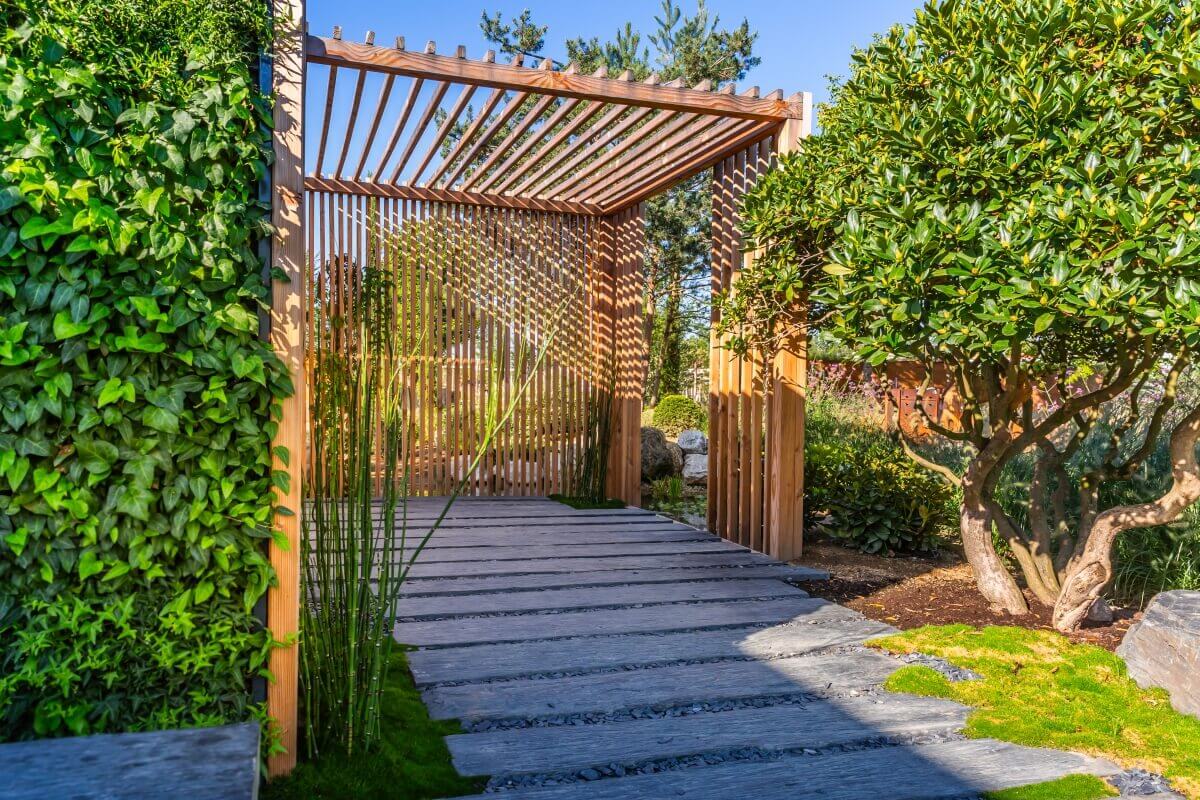
Yes, balcony recess panels improve the functionality of the space, as they organise the recess, provide a screen and offer a stable base for plants, built-in furniture or a relaxation area. When arranged in an openwork pattern, they increase privacy and deflect gusts of wind whilst maintaining air circulation. Boards 18–28 mm thick and 90–145 mm wide are typically used, with 10–20 mm gaps providing a balance between screening and ventilation. Durability depends on a rigid frame, a 5–10 mm gap from the floor, and regular renewal of the protective coating every 18–36 months.
Are balcony recess boards a simple way to make your balcony more functional?
Balcony recess panels can genuinely improve the functionality of the space, as they organise the recess, provide privacy and create a practical backdrop for built-in furniture, plants or a relaxation area. In practice, this is one of those elements that makes a difference without the need for a major refurbishment. At Dąb Gaj Wood, we treat such solutions as small-scale architecture: they should look premium, but above all, they must work well in everyday use.
If the recess is exposed to the wind, prying eyes from neighbours, or simply looks unfinished, well-chosen balcony recess boards They help to enclose it both visually and functionally. They are most commonly installed as an openwork screen, a cover or a lightweight balustrade enclosure, so as to allow air to circulate and prevent the balcony from becoming an airtight box.
Do balcony enclosure panels improve privacy and provide protection from the wind?
Yes, balcony screen panels improve privacy and reduce draughts, as they act as a screen that deflects the wind and conceals the most exposed parts of the balcony. An openwork design works best: it provides cover without completely blocking the flow of air. In practice, the balcony is no longer completely exposed, yet it doesn’t get stuffy on hot days.
A balcony recess is usually a place where the wind swirls between the walls. Balcony recess boards placed vertically with a 10–20 mm gap can calm this air movement enough to allow you to sit comfortably at a table or place taller plants without the pots constantly toppling over. If you value privacy more than ventilation, the gaps can be reduced to 5–10 mm, but you’ll need to ensure the wood is well-protected and has room to breathe.
From a practical point of view, there are two other important factors: height and rigidity. You will most often find screen modules with a height of 120–180 cm, and the frame itself (if there is one) should have a sensible cross-section, e.g. around 40×60 mm or 45×70 mm, so that the whole structure does not rattle in the wind. The boards for balcony recesses must not ‘rattle’ like a window blind, as the joints will quickly become loose and this will become a daily nuisance.
What type of wood and what dimensions are best for making boards for balcony recesses?
Dimensionally stable, well-seasoned timber works best, and the boards for balcony recesses should be chosen so that they do not warp in the sun and rain. In practice, the aim is for a thickness of around 18–28 mm and a width of 90–145 mm, depending on the design and whether it is a solid structure or an openwork screen. The wider the board, the more attention must be paid to the quality of the material and its protection, as it is subject to greater stress.
Spruce or pine in construction-grade quality is often chosen for balcony recesses, but preparation is key: drying, planing and dimensional consistency. Larch (which is naturally more durable) also performs well in premium solutions, although it is more expensive. If the boards for balcony recesses are to form a load-bearing element for shelves, boxes or built-in units, then I wouldn’t experiment with random material from a DIY store, but would opt for timber with proven specifications, straight-grained and without twisted fibres.
When it comes to the finer details, the edge matters too. In practice, boards with a slight rounding (2–4 mm radius) withstand outdoor conditions better than those with a sharp edge, as the protective coating lasts longer. And one more thing that only becomes apparent after a season: boards for balcony recesses installed horizontally should have a slight slope or gap to prevent water from pooling on the edges. A vertical layout is usually more trouble-free.
How much do balcony recess boards and their installation actually cost?
The cost depends on the type of wood, the finish, and whether we are making a standard screen or a bespoke installation, but panelling for balcony recesses usually ranges from around PLN 900 to PLN 2,500 per module 1–2 m wide. If the recess has an unusual shape, requires additional frames or cover panels, or needs to be fitted to an existing balustrade, the price increases. The biggest difference in cost stems from the time taken to fit the structure and the quality of the finish.
To be specific: for a recess measuring 120×250 cm (width × height), a simple openwork panel made of 20–22 mm planks, mounted on a frame and weatherproofed, would typically cost around PLN 1,200–2,000. If you add side panelling, ‘closing off’ the corners and neatly concealing the fixings, the cost realistically rises to PLN 2,000–3,500 per set, as the amount of carpentry and installation work increases.
There are three key factors to consider during installation: the method of fixing, the distance from the wall, and the movement of the wood. Boards for balcony recesses should be installed 5–10 mm away from the ground/floor to prevent them from drawing in moisture. It is best to install the fixings in such a way that they can be serviced: tightened, the board replaced, or the finish touched up. In practice, this saves a lot of hassle after 2–3 seasons.
- The cheapest option is a ready-made module + simple installation on a wall or balustrade post, with no mitre cuts and no cover plates.
- The standard option involves fitting the unit into a recess, including frames, attractive cover strips and concealed joints, so that the whole unit looks like a permanent feature of the architecture.
- The most expensive option includes a multi-unit unit (sides, front, corners), sometimes with space for plant pots, shelves or integrated lighting.
How should you maintain balcony recess boards to ensure they last for years?
To ensure that balcony recess boards remain functional for years to come, they must be cleaned regularly and their protective coating renewed before the wood starts to turn grey and absorb water. Under typical balcony conditions, a sensible refreshment interval is every 18–36 months, depending on the amount of sunlight and whether the recess is sheltered from the rain. The most important thing is to prevent the coating from flaking, as this allows water to penetrate the wood and causes the material to deteriorate.
Maintenance doesn’t have to be a chore. First, wash the surface (using a mild wood cleaner and a soft brush), then lightly sand down any areas where the finish is worn, and apply a single coat of oil or wood stain that matches the existing finish. Boards for balcony recesses, which are in constant shade and trap moisture, require more attention than those under a large overhang, as they dry out more slowly after rain.
It’s also worth giving the joints a quick check once a season: make sure the screws are secure, there are no cracks at the edges, and that the spacers haven’t been ‘eaten away’ by dirt. If water and dirt accumulate at the bottom edge, functionality deteriorates most rapidly: it becomes slippery, unsightly and harder to keep clean. Well-made balcony recess boards can easily last 10–15 years, and with regular refinishing, often longer, as the wood is not exposed to excessive moisture.
- Wash the recess and the boards 2–3 times a season, especially after flowering and in the autumn, as dirt traps moisture.
- Reapply the coating when the colour has noticeably faded and water no longer beads on the surface.
- Check the lower areas near the floor and the corners, as that’s where damp-related problems usually start.
If you want the decking for your balcony recess not only to look good but also to genuinely improve the comfort of using your balcony, it is essential to adapt the layout to the wind, the sun and how the recess is used. A well-designed module can transform a difficult corner into a space you use every day, not just on special occasions. If necessary, it is worth consulting the design and installation with a contractor who works with proven timber and can predict how the structure will perform after a few seasons — this is where Dąb Gaj Wood.
Read also: How do you choose the perfect boards for rustic gazebos?
Frequently asked questions
How long does it take to make made-to-measure boards for a balcony recess?
For a simple module, the lead time is usually between 1 and 3 weeks, but for recesses with unusual shapes, it may take up to 4–6 weeks. The most time-consuming stages are adjusting the dimensions, preparing the frame and finishing (oil/wood stain) prior to installation. The installation on the balcony itself usually takes between 2 and 5 hours, depending on the number of components and the method of fixing.
How do you prepare a balcony before installing decking in the recess?
Clear out the recess and ensure access to the walls and balustrade along the entire height of the planned screen. Check that the floor surface is clean and allows water to drain away, as the lower section is most prone to collecting moisture and dirt. If the façade is insulated, it is worth agreeing with the contractor in advance where the fixing points will be and what spacing will be used.
How do you choose the spacing between the slats to ensure privacy and ventilation?
Gaps of 10–20 mm are most commonly used, as this openwork design provides cover without turning the balcony into an ‘airtight box’. When privacy is a priority, the gaps can be reduced to 5–10 mm, but this makes it all the more important to ensure the wood is well protected and that there is adequate ventilation. The choice should be based on the direction of the sun and the wind in the specific recess, as in some configurations, too dense a structure can reduce comfort in hot weather.
Is it possible to fit the boards without drilling into the façade or the balustrade?
Sometimes, but it depends on the balcony’s construction and whether the module can be safely mounted on the existing structure without the risk of it ‘moving’ in the wind. Without drilling, it is harder to achieve rigidity, and this is crucial to ensure the cladding does not come loose after the season. However, serviceable point fixings are most commonly used, allowing joints to be tightened or a board replaced if necessary.
How often do you need to reapply oil or wood stain to the decking on the balcony?
Under typical balcony conditions, the coating should be refreshed every 18–36 months, depending on sunlight and exposure to rain. Signs that action is needed include a noticeable dulling of the colour and the absence of water beading on the surface. Regular washing 2–3 times a season significantly extends the coating’s lifespan and maintains the functionality of the balcony.