


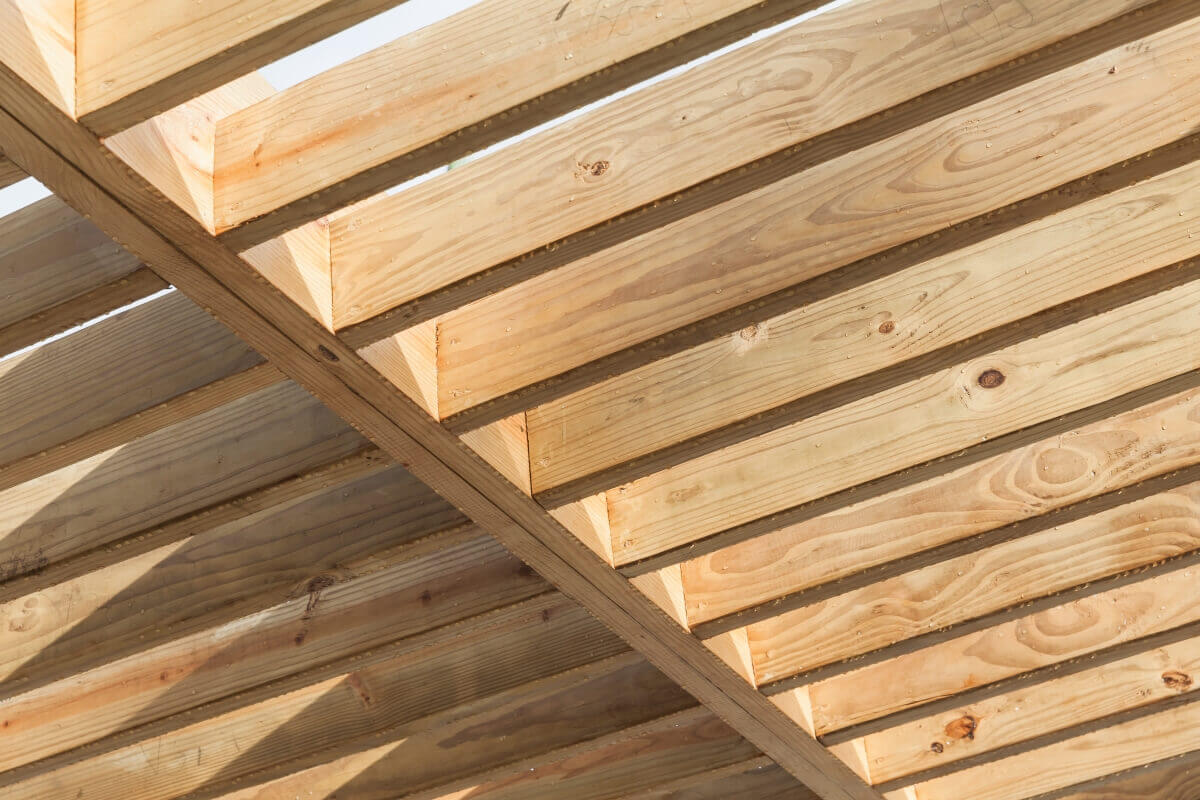
The ideal boards for a rustic-style arbour are chosen by selecting stable, well-seasoned timber (approx. 12–18% moisture content) and a profile that highlights the grain and does not warp after a season. Spruce (C24/KVH) is most commonly used for its uniformity and ease of staining, larch for greater weather resistance, and pine provided it is regularly treated. A rustic effect is achieved with brushed boards or those with a 1–3 mm chamfer, usually 18–22 mm thick and 90–140 mm wide, with a 10–20 mm gap in openwork installations.
Which gazebo boards should I choose to keep the rustic style looking natural and holding up for years to come?
In a rustic arbour, the authentic look of the wood is what matters most, but it is equally important that the arbour boards do not warp after the first winter or start to turn blue. It is possible to achieve both if, from the outset, you choose the right species, profile and finish for the conditions in your garden.
Dąb Gaj Wood designs these elements with real-world use in mind: rain, sunshine, temperature fluctuations and everyday life on the terrace.
If you are looking for ready-made, tailor-made components for walls, covers and details, see gazebo boards in a version that is easily incorporated into rustic columns, braces and traditional roofing.
What is the best wood for rustic gazebos?
The best boards for rustic-style gazebos are those that combine stability with a nice grain pattern: usually spruce/Scandinavian spruce, Siberian larch or pine, and in the premium version also glulam elements (e.g. glulam) where straightness is important. You don't need exotics for a rustic effect - you need well-dried material and a sensible cross-section.
In practice, the most common choice is:
- Spruce (C24, KVH for structural components) — even-grained, stable, easy to stain; excellent if you’re looking to achieve a rustic look through colour and brushing rather than the curvature of the board.
- Larch - more resinous and more resistant to conditions, ages nicely; worth giving to areas more exposed to rain and sun.
- Pine - graceful to work with and cheaper, but requires consistent waterproofing and regular refreshing of the coatings as it works faster and catches discolouration.
For a rustic gazebo, it is also important that the gazebo boards have a repeatable moisture content (usually around 12-18% depending on the intended use). Wood that is too wet will start to shrink after installation, and gaps and cracks will appear where they are most visible from the perspective of a bench or table.
If the gazebo has a strong, load-bearing structure, 18×18 cm posts and KVH or BSH beams (e.g. GL24) are a sensible standard - and gazebo boards are then selected as a covering and decorative layer, already under style and privacy.
Which gazebo boards give a rustic effect: planed, brushed or bevelled?
The easiest way to achieve a rustic effect is to use brushed planks or those with a visible chamfer on the edges, as this allows the light to highlight the grain pattern, giving the arbour a softer, less ‘catalogue-like’ look. Planed boards are the smoothest and most pleasant to the touch, but in a rustic style it’s worth breaking up their uniformity with a detail: a bevelled edge, a brushed finish or a slightly weathered colour.
Definitions that really help you choose:
A planed board is a board that has been smoothed over its entire surface — it is easy to keep clean and is ideal for cladding inside a gazebo and for parts that you touch. A brushed plank has the softer parts of the wood selectively removed — it has a more vibrant appearance and better conceals minor scratches.
A chamfer is the bevelling of an edge (usually 1–3 mm), which neaten the joint line and reduces fraying at the edges.
For rustic gazebos, 18–22 mm thick and 90–140 mm wide gazebo boards usually work best. Wider boards have a more rustic look, but they’re also more prone to warping — which is why, for widths exceeding around 145 mm, I make sure of two things: that they’re properly seasoned and correctly fixed (to prevent them from cupping).
If you are planning an openwork development, a horizontal layout with a 10-20mm clearance works well. This gives rusticity and airiness and, incidentally, the gazebo boards dry out quicker after rain, which realistically extends the life of the coating.
How do you install gazebo boards so they don't crack or catch moisture?
To ensure that gazebo boards do not crack and draw moisture, install them with a distance from the ground, with gaps for the wood work and with stainless steel screws. It is also crucial to protect the face of the board (the end), as this is where the wood absorbs water fastest.
In practice, I stick to a few rules that make a difference after 2-3 seasons:
- Distance from the ground a minimum of 30-50 mm - the board must not stand in water or collect splashes from the ankle; this is the easiest way to reduce blue stain and fungus.
- Expansion gaps of 3-6 mm - wood works; without a gap, gazebo boards can push out and bend, especially on full builds.
- A2/A4 stainless steel screws and drilling at the edge - you reduce cracking and don't have black streaks from corrosion years later.
For vertical covers, it is a good idea to give a lath grate to create a ventilation gap behind the board (minimum 10-20 mm). A rustic gazebo often stands in greenery, in semi-shade, and there moisture holds longer. Ventilation behind the build-up is the silent hero of durability.
How do you maintain rustic gazebo boards and how much does it cost per year?
Rustic-style gazebo boards are maintained regularly, but without exaggeration: the standard is to inspect once a year and refresh the coating every 2-4 years, depending on exposure to sun and rain. The most important thing is to prevent the coating from flaking - because then water gets underneath and the work begins, cracking and greying in spots.
To be clear: in this context, impregnation isn’t just about biological protection, but also colour stabilisation and reducing water penetration. Oils and wood stains work really well in a rustic style, as they highlight the wood grain and don’t give a plastic-like finish. If your arbour is in full sun, choose products with UV filters and expect to have to reapply the treatment more frequently on the south-facing side.
What a realistic timetable for a garden shed looks like:
Every season (spring): wash with a mild wood polish, inspect joints and face of boards, spot touch-ups. Every 2-4 years: refresh the whole with a thin coat of oil/ glaze; on the sunniest sides sometimes every 2 years, in the shade more often every 3-4 is sufficient.
Well-maintained garden arbour boards can look very good for 10–15 years, whilst the supporting structure itself (provided the timber is of good quality and it is assembled correctly) can easily last for 20–30 years.
If you want to select boards for a specific rustic project (colour, brushing, layout, clearances) and be sure that the overall design will be consistent with the structure, get in touch with Dąb Gaj Wood, where you can choose a solution that will look natural and won’t require constant touch-ups.
Read also: Do wooden garden sheds require frequent maintenance?
Frequently asked questions
Can I order boards to size for specific clearances and layout?
Yes, it is safest to choose the width of the board and the planned clearance (e.g. 10-20 mm) already at the design stage, as this affects the amount of material and the spacing of the grid. It is also worth determining the thickness (often 18-22 mm) and whether the boards are to be chamfered or brushed from the outset, as this changes the final rustic effect. For pricing and preparation, you will need the dimensions of the installation areas and whether the layout is to be vertical or horizontal.
How long does it take to prepare and implement the gazebo boards?
The time depends on whether you go for standard sections or a brushed and stained version for the rustic, as this requires additional processing. Usually the fastest to go are pieces in popular sizes, while it takes longer to prepare larger batches with repeatable moisture and finish. To avoid delays, provide the build area, preferred profile and side of exposure (sun/shade) from the outset, as this affects the choice of coating.
How do I prepare the site for installation so that the boards do not draw moisture from below?
Leave a distance of at least 30-50 mm between the boards and the ground and do not allow the bottom edge to stand in water or catch splashes from the cube. For fuller builds, plan for a grate and a ventilation gap behind the board (minimum 10-20 mm), as moisture lasts longer in the half-shade. Also protect the front of the boards, as the ends absorb water the fastest and this is where cracks and discolouration usually start.
For a rustic gazebo, would brushed or planed boards be better for the utility side?
If you frequently touch the surface (e.g. inside a gazebo, near the benches), the planed side is easier to clean and collects less dirt. Brushing gives a stronger rustic effect and better conceals minor scratches, but dust and pollen may settle more quickly in the grooves. A common compromise is to brush the external façade and leave the side facing the user with a smoother finish.
How often do the boards need to be oiled or varnished and what affects colour fastness?
It is most common to do an inspection once a year and to refresh the coating every 2-4 years, with the south side able to require renewal closer to 2 years. Colour fastness is most strongly affected by the sun, rain and whether the coating has UV filters and whether the wood has the ability to dry quickly after rainfall. When the coating starts to peel, it is worth reacting immediately, as water gets underneath and accelerates cracking and uneven greying.