


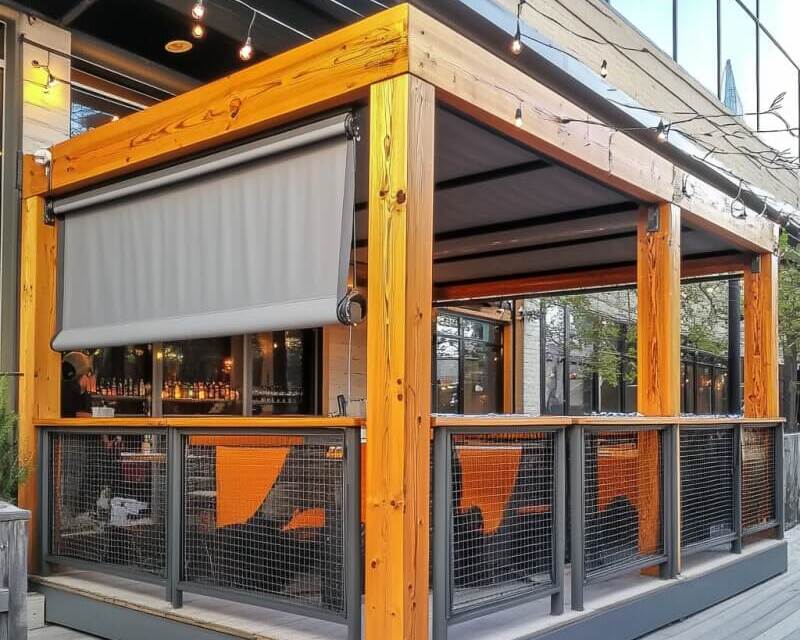
Wooden patio blinds with a movable mechanism operate by simultaneously rotating all the slats within the frame, which adjusts the amount of light, shade and ventilation without the need to dismantle any parts. The movement is achieved by the slats mounted on axles and by control cords with a guide rail, which transmit the change in angle to the entire stack so that it operates evenly. The most common configurations are a rotation system with a range of approximately 0–90° or a tilt-and-slide system, where closing the shutters creates a more airtight barrier.
How do wooden patio blinds with a movable mechanism improve patio comfort and privacy?
Wooden patio blinds with a movable mechanism act like an adjustable screen: in a matter of seconds, you can adjust the angle of the slats to let in light, block the wind or provide privacy from neighbours. You’ll particularly appreciate this solution on a terrace facing the street, next to large windows, or in a dining area with a barbecue, where you might want a draught at one moment and peace and shade the next.
Dąb Gaj Wood manufactures these covers from KVH and BSH structural timber, as dimensional stability and the precision of the mechanism’s operation are crucial in moving systems.
If you are considering such a solution, see how the following look in practice wooden patio blinds with movable mechanism in the terrace development and which control variants can be selected for daily use.
How do wooden patio blinds with a movable mechanism work and what exactly moves in them?
Wooden patio blinds with a movable mechanism work by adjusting the angle of the slats within a single frame, allowing you to control the amount of light, shade and airflow without having to remove any parts. The movement involves the slats (boards) themselves and the pull cords, which transfer the rotation to the entire stack so that all the slats operate evenly.
In practice, it works on a similar principle to window blinds, but in a version designed for patios: larger cross-sections, stronger joints and weather resistance.
You will most commonly encounter two operating arrangements. The first is a pivoting arrangement, where the lamella rotates on its axis and changes its angle in a range of roughly 0-90 degrees (depending on the profile and where it is installed). The second is the tilt-and-slide arrangement, where the lamella has limited rotation but is positioned to form as tight a partition as possible when closed.
Structurally, the whole assembly consists of a frame (uprights and crossbars), a set of slats and a motion-transfer mechanism. In a well-made system, there is no play, which would otherwise start to rattle in the wind once the season is over.
Modules typically used for terraces are around 90–180 cm wide and 200–260 cm high, as these dimensions fit easily against a pergola, a terrace recess or the side of a gazebo, whilst maintaining stability and ease of use.
It is worth bearing one thing in mind: wooden patio blinds with a moving mechanism are designed to operate smoothly, but they must not be fitted too tightly. Wood is a living material, so controlled gaps are left and corrosion-resistant fittings are used to ensure that the mechanism continues to operate smoothly after exposure to rain and sun.
What wood and sections are used to make wooden patio blinds with a movable mechanism so that they do not warp after a season?
To ensure that wooden patio blinds with a moving mechanism do not twist or become wedged in the frame, two factors are crucial: sturdy structural timber and appropriately sized slats and frames.
The most reliable options are KVH (solid, kiln-dried and micro-finger-jointed) and BSH GL24 (glued laminated timber), as they offer predictable behaviour and a lower risk of warping than random-length sawn timber. In practice, when it comes to movable shutters, it is better to pay a little extra for the stability of the material than to have to struggle with adjustments every few weeks.
Slats are often made with dimensions of around 20–28 mm in thickness and 70–120 mm in height (depending on the span and the visual effect). For longer slats, a taller profile works better, as it is less susceptible to wind.
The frame of a modular unit is usually more substantial than that of fixed panels; in practice, it makes sense to stick to cross-sections of around 45×95 mm, 60×120 mm or similar, depending on the size of the panel and how it is fixed to the pergola posts.
The species of wood also matters. The most common choices are structural quality spruce/Scandinavian (takes impregnation well), larch (more naturally resistant but can work), sometimes pine (if well dried and treated). Regardless of species, starting moisture content, selection without large knots in the hardware zones and protection of cut edges are key.
If anyone asks what is the safest option for a sliding system designed to last for years, the answer is: KVH or BSH GL24 structural timber, stainless steel or galvanised fittings with enhanced durability, and a finish using oils and wood stains with a UV filter. In this case, wooden patio blinds with a retractable mechanism can operate reliably for 10–15 years or more, provided they are properly maintained.
How do you install wooden patio blinds with a movable mechanism and what mistakes most often spoil their operation?
The installation of wooden patio blinds with a movable mechanism involves perfectly levelling the frame, aligning the slats’ axis of rotation, and adjusting the pull cords so that all the slats open evenly. If the frame is warped by even a few millimetres, the mechanism begins to pull unevenly and, over time, play or binding will occur.
That is why the supporting structure (pergola, posts, wall) is erected first, and only then are the blind modules fitted.
In practice, the installation process is as follows: securing the frame to the posts or wall (allowing for expansion joints), checking the diagonals, positioning the slats on the axles, attaching the control strip and testing the full range of movement. For larger modules, additional guide points are used to prevent the wind from causing the slats to flap.
In very windy areas, it is also worth providing for a service position in which the slats are tilted so that they allow the wind to pass through, rather than acting like a sail.
The most common mistakes in the field are:
- Lack of process play in the frame and at the fins, so that after rain the wood swells and the mechanism starts to wedge.
- Mounting the module to a curved substructure without shims or adjustments, resulting in constant tension and geometry divergence.
- Poorly chosen fittings or screws that catch corrosion and after a season begin to resist movement.
- Omission of edge protection after cutting on site, so that water enters the section and accelerates degradation of the coating.
If wooden patio blinds with a movable mechanism are to be part of a larger patio development, it is a good idea to plan for water drainage and cover sensitive areas from the outset. Even the best coating does not like a permanent puddle on the bottom transom or in the mounting pocket near the floor.
How do you maintain wooden patio blinds with a movable mechanism and how much does this cost per year in real terms?
Wooden patio blinds with an adjustable mechanism are maintained in much the same way as a wooden façade, but with greater emphasis on the moving parts: regular cleaning, checking the finish and responding promptly to any wear and tear. Under normal conditions, an inspection twice a year (in spring and autumn) is sufficient, and the finish should be refreshed every 2–4 years, depending on sun exposure and colour.
The more sun and rain it is exposed to, the more often you need to reapply the protective layer.
The simplest service routine looks like this:
- Wash the fins and frame with a mild wood polish and a soft brush so as not to scuff the coating at the edges.
- Checking the pivot points and links: if there is any resistance, remove any dirt and check that they are tight, rather than forcing the mechanism.
- Refresh the coating in the areas most exposed to UV and water, especially on the upper edges of the fins.
Costs? Refurbishing the finish (materials + labour) on larger windows usually costs several hundred to several thousand zlotys, as it depends on access, the dismantling of small components and the precision of the work around the edges.
As for the cost of manufacturing and installing the whole system, wooden patio blinds with a movable mechanism are usually more expensive than fixed panels, as you are paying for precision and the fittings.
In practice, the price of modules can start at a few thousand zlotys for a smaller unit, whilst larger terrace side enclosures can cost over ten thousand zlotys or more, depending on their dimensions, the type of control system and the finish.
The fairest way to price this is based on the dimensions and installation conditions, as the amount of work involved differs between a straight side of a pergola and a recess with an uneven wall and a sloping floor.
If you want the mechanism to run smoothly for years to come, treat maintenance in the same way as you would look after your patio: it’s better to do a little bit at a time than to have to renovate everything all at once later on.
If you have any questions about selecting modules, controls and finishes to suit a specific exposure to sun and wind, you can discuss the solution with Dąb Gaj Wood and select a system to match your pergola or terrace development.
Read also: Do systemic lamella canopies fit into modern terraces?
Frequently asked questions
How long does it take to realise and install movable louvre blinds?
The mere installation of one-two modules on a prepared structure can usually be done in 1 day, and the larger development of the terrace sides can usually be done in 1-2 days. The lead time from measurement to installation depends on the production and finishing, but in practice is often several weeks. It can take the longest time to adjust for uneven walls and floors and to prepare stable fixing points.
How do I prepare the site for the installation of blinds on the terrace?
The most important thing is to ensure straight, stable fixing planes: plumb on the columns/wall and level on the transoms, as a crooked base immediately spoils the work of the mechanism. It's also a good idea to leave room for expansion joints and water drainage so that the bottom transom doesn't stand in a puddle. Before installation, remove obstructions at the edge of the terrace (plant pots, slats, lamps), as access to adjust the tendons and slat axis is crucial.
Is it better to choose KVH or BSH for a movable lamella system?
For moving louvres, KVH is most often chosen for components where stability and repeatability are important, and BSH GL24 where there are higher loads and even greater predictability of operation is needed. In practice, both materials work well if they are properly protected and have the correct cross-sections for the module dimension. If you want maximum stability for larger sizes, BSH is sometimes the safer choice for frames and load-bearing elements.
What can be done to prevent the mechanism from clunking after rain and in winter?
Technological clearances in the frame and at the slats are crucial, as well as corrosion-resistant hardware, because wood swells after rain and needs room to work. Regularly clean the pivot points and linkages of dust and tarnish, and at the first resistance, do not force the movement, but remove the dirt and check the tightening. In windy locations, it also helps to put the fins in the service position so they don't act like a sail in gusts.
Is it possible to order blinds to size and match the colour to the pergola?
Yes, modules are usually selected for the specific width and height of the niche or side of the pergola, as this affects the stability of the frame and the lightness of the lamellas. The colour and opacity can be matched by selecting a varnish or oil with a UV filter, while also taking into account exposure to sun and rain. With unusual dimensions, it is advisable to plan the divisions into modules at the outset, so that the sashes are not too wide and do not catch catch in the wind.