


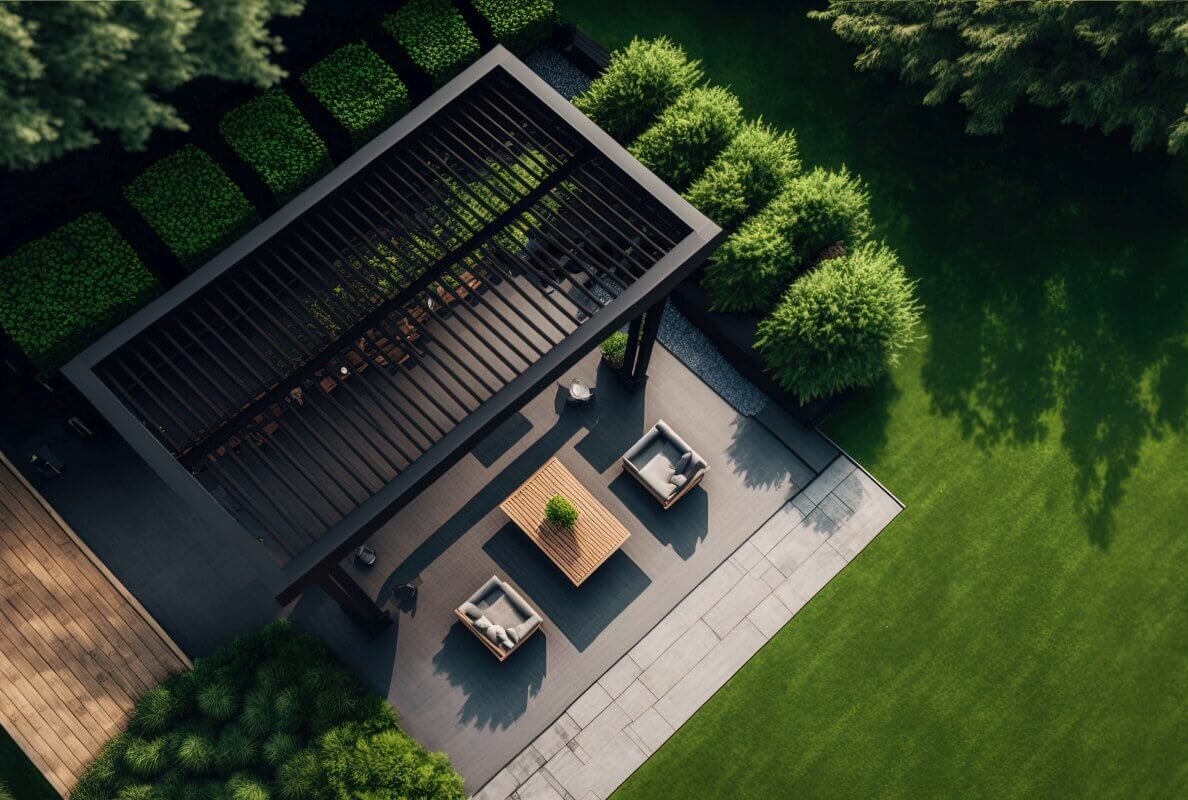
Wooden balcony pergolas are suitable for small balconies, provided the structure is adapted to the dimensions of the balcony slab, the balustrade and the anchoring options. In a small space, wall-mounted or corner configurations work best, as they minimise the number of posts and do not obstruct movement. Typical functional dimensions are a depth of 80–140 cm and a width of 120–240 cm, whilst maintaining a minimum passage width of 60 cm (ideally 70–80 cm).
Are wooden balcony pergolas suitable for small balconies in blocks of flats and detached houses?
Wooden balcony pergolas are certainly suitable for small balconies, provided they are well suited to the dimensions of the balcony slab, the balustrade and the way the balcony is used. Dąb Gaj Wood designs such structures so that they do not take up valuable space, whilst at the same time providing shade, protection and visual order.
The most important decision is usually which layout to choose: wall-mounted, corner or freestanding on legs, as this determines whether there will be enough space to walk past it. If you’re considering wooden balcony pergolas, so right from the start it’s worth following a simple rule: on a small balcony, what matters is a light, airy look, secure fixing and the ability to adjust the shades.
How can you fit wooden balcony pergolas onto a small balcony without them taking up too much space?
Wooden balcony pergolas can be adapted to a small balcony so that they don’t take up too much space, provided you limit the number of posts and position the structure against a wall or in a corner. The most practical pergolas are those 80–140 cm deep and 120–240 cm wide, as they provide effective shelter whilst still leaving enough space for a walkway and a table or a storage chest.
A definition worth knowing: a balcony pergola is a lightweight wooden structure mounted on a wall, balustrade or on feet, which provides a frame for coverings (slats, roller blinds, panels, plants) and helps to organise the space. On a small balcony, two layouts work best:
- A wall-mounted design with two front legs: stable and easy to assemble, whilst the back rests against the wall, so there’s no need to place all four legs on the balcony floor.
- Corner layout: it provides shelter from the wind and neighbours on two sides, whilst leaving more space in the middle for movement.
In practice, I make sure that the passageway is at least 60 cm wide, and ideally 70–80 cm. If, for example, a balcony is 110–120 cm deep, wooden balcony pergolas are usually designed as narrow frames (80–100 cm) with a canopy on the side facing the balustrade, rather than as a full roof covering the entire area.
The height is usually between 220 and 260 cm, depending on the floor and the anchoring options.
What type of wood and what cross-sections should be used for wooden balcony pergolas in a small space?
Wooden balcony pergolas for a small balcony should be made from dimensionally stable timber that will not warp in response to changes in humidity and temperature. The safest structural choice is KVH or BSH in GL24 grade, as these retain their shape and withstand point loads better than random solid timber.
Definition in a nutshell: KVH is micro-finger-jointed, kiln-dried and planed structural timber; BSH (glued laminated timber) is even more stable and ideal for beams. On a balcony, where everything is in plain sight and close to the user, this stability translates into both aesthetics and safety.
Cross-sections are selected to suit the span, but on small balconies there is no point in oversizing them. The most common and practical values are:
- 9×9 cm or 12×12 cm posts: given their small dimensions, they look proportionate and, when properly anchored, provide sufficient rigidity.
- 6×12 cm or 8×12 cm beams: with a width of 160–240 cm, they help maintain a straight line and do not appear to sag.
If you’re planning to use movable screens or closely spaced slats, it’s worth using a sturdier beam (e.g. 8×12 cm) and more robust joints, as there will be additional wind load. On a small balcony, it is the wind and the ‘sail’ effect created by the screens that make the biggest difference, rather than the weight of the timber itself.
How much do wooden balcony pergolas cost for a small balcony, and what factors influence the price?
The cheapest options are simple wall-mounted frames without moving parts, whilst the most expensive designs are those with sliding systems or integrated covers, which require precise guidance and fixings.
Cost breakdown: when you get a quote for a balcony pergola, you’re not just paying for the timber, but also for a design tailored to your specific wall and balustrade, fittings, anchoring, surface protection and installation labour. It can be even trickier on a small balcony than on a terrace, as there is less room to manoeuvre and the work must be carried out with the utmost care.
The price is mainly influenced by a few factors, which I always discuss with the client before we start:
Firstly, the dimensions: a 120×90 cm pergola will be significantly cheaper than a 240×140 cm one, as the amount of material increases, and above all, the installation time and the number of fixing points. Secondly, the shading systems: fixed slats are simpler, whilst movable systems (e.g. sliding panels or adjustable shades) increase the cost, as they require guides, carriages, precise adjustment and maintenance.
Thirdly, the finish: impregnation and staining with UV-filtered oils (e.g. oil-based systems for external timber) offer effective protection, but also involve an extra step in the process.
If you want to keep costs down whilst still achieving a premium look, a simple wooden frame plus a single sturdy screen on the side most exposed to neighbours or the sun works well in a small space. Wooden balcony pergolas don’t need to be elaborate to do the job.
How should you install and maintain wooden balcony pergolas so that they last for years on a small balcony?
Wooden balcony pergolas will last 10–20 years on a small balcony, and even longer if they are properly anchored and regularly maintained. The key is to protect them from standing water, ensure the wood is well ventilated, and refresh the finish every 1–3 seasons, depending on exposure to sun and rain.
Installation guidelines: a balcony pergola is correctly installed when the loads are transferred to the building’s structural elements (wall, ring beam, solid slab) via suitable anchors and fixings, and the timber is not in constant contact with water. On the balcony, I pay particular attention to the distances from the floor and ensure that the base of the post does not stand in a puddle after rain.
In practice, the installation process is as follows: first, the substrate is measured and checked (slopes, drainage, condition of the balustrade and wall), then the anchoring points are marked out. The posts are placed on adjustable feet or suitable bases, whilst the wall-mounted components are fixed to the load-bearing substrate, not to the insulation layer itself.
On small balconies, it is also important to ensure that the structure does not interfere with the door, external roller shutter or window sash.
Maintenance isn’t difficult, but it must be carried out regularly. It’s worth doing a quick check every season: check for cracks in the coating, check that water isn’t pooling in the corners, and check that the fastenings are tight.
Oil or wood stain is usually reapplied every 1–2 years on south- and west-facing balconies (strong UV rays), and every 2–3 years on the north side, where there is less sun. If the wood starts to turn grey, this is a sign that the UV filter is no longer effective and it is time for a refresh before moisture starts to penetrate deeper.
If you approach the matter sensibly, wooden balcony pergolas on a small balcony are one of the most rewarding investments: they improve comfort, provide shade and privacy, and do not require any major building work.
If you want it to be well designed and built to your specifications right from the start, it’s worth relying on the experience of a team that does this sort of thing every day — in Dąb Gaj Wood We guide the customer through every stage, from taking measurements to installation, to ensure the result is long-lasting and simply convenient to use.
Read also: How can wooden pergolas on a balcony enhance privacy?
Frequently asked questions
Does a pergola for a small balcony have to be attached to the wall?
It isn’t essential, but a wall-mounted layout usually saves the most space, as it rests against the wall at the back and minimises the number of posts on the balcony slab. A corner layout is often better if you want to be sheltered from neighbours and the wind on two sides. The final choice depends on where your balcony doors are located, how the door leaf opens, and where it’s actually possible to install secure fixings.
What is the minimum width of the passageway to leave next to a pergola on a small balcony?
In practice, it’s worth leaving a minimum of 60 cm of clearance, or 70–80 cm for comfort, so that you can easily walk past a table, a chest or some planters. For balconies with a depth of around 110–120 cm, this often means a narrower pergola, typically between 80 and 100 cm wide. This ensures that the pergola provides shelter on the side facing the balustrade, whilst not obstructing passage.
Is it better to choose KVH or BSH for a balcony, and when does it matter?
KVH is a good choice for most small balcony pergolas, as it is kiln-dried, planed and dimensionally stable. BSH is worth considering if you have longer beams, want a very clean line without any visible wood grain, or are planning heavier canopies and higher wind loads. In practice, the difference is most noticeable in beams and exposed elements, where geometry and aesthetics are key.
How long does it take to install a balcony pergola, and how should I prepare the balcony before the team arrives?
Installing a small balcony pergola usually takes 1 day, though this may take up to 2 days for more complex structures. Before installation, it is worth clearing the balcony, ensuring access to the wall and balustrade, and checking that the drain and floor slopes are working correctly. It is also a good idea to make sure that the structure will not interfere with the door, external roller shutter or the opening of the window.
How often should you reapply the finish (oil/wood stain) to a balcony pergola?
On balconies exposed to strong sunlight (south and west-facing), the coating is usually refreshed every 1–2 years, as UV light causes it to fade most quickly. On the north-facing side, it is usually sufficient to renew the coating every 2–3 years, provided the timber is well ventilated and is not standing in water. If the timber starts to turn grey or the coating cracks, this is a sign that it is worth renewing the protective coating before the next season.