


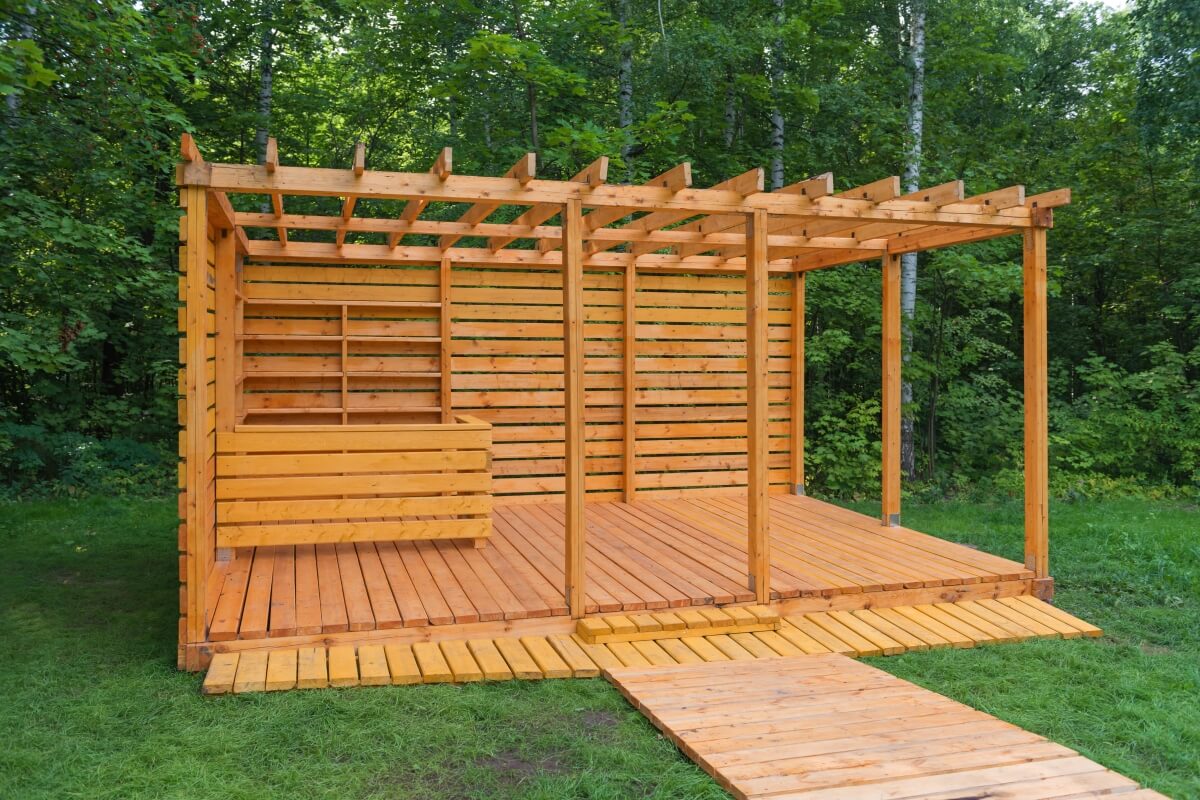
Yes, walls for wooden gazebos enhance privacy by blocking the line of sight at eye level; they are usually 180–200 cm high, and where slats are used, a gap of 10–20 mm limits the visibility of silhouettes. Effectiveness depends mainly on the type of panelling (solid, openwork, slatted), the orientation of the screen relative to the direction of unwanted views, and exposure to wind, as solid panels generate greater wind pressure. Well-made screens usually last 10–15 years, provided the surface is treated with oil or wood stain every 2–4 years (south- and west-facing sides require more frequent checks after winter).
Do timber gazebo walls really give privacy in the garden?
Timber gazebo walls can realistically cut off the view from neighbours and the street, but the effect depends on whether you choose full infill, openwork laths or a mixed arrangement. In practice, privacy is not a buzzword here, but a concrete geometry: height, clearance and positioning in relation to the world.
At Dąb Gaj Wood, we design gazebos every day so that the covers are not an add-on at the end, but part of the structure that improves comfort, acoustics and wind protection. If you would like to see the variants and installation solutions available, check out the walls for wooden gazebos matched to the specific dimensions of the gazebo and the layout of the garden.
How do wood gazebo walls increase privacy and when does it work best?
Yes, wood gazebo walls increase privacy because they limit the line of sight at human height and create a clear optical barrier. This works best if the screen is at least 180-200 cm high or is positioned exactly in the direction from which you get unwanted glances (neighbour, road, entrance to the property).
Definition in practice: privacy is not just about preventing people from seeing inside, but also about feeling sheltered whilst sitting at the table. That is why a design is often adopted in which the lower section is more solid (e.g. with closely spaced slats), whilst the upper section allows light and air to pass through.
In gazebos with a typical span between posts of 2.0–2.5 metres, it makes sense to cover two-thirds of the span with a screen, leaving a section open to provide a view of the garden.
It is worth bearing in mind the wind. Solid walls for wooden gazebos give the best visual cover, but they also catch gusts. When exposed to open space, laths with a 10-20 mm clearance or an alternate arrangement work better, as the structure works more quietly and the gazebo does not get stuffy.
- Full board infill: highest privacy and best wind protection, but higher wind load and need for stronger joints.
- Fixed laths: good privacy at the right angle and spacing, better ventilation and a lighter visual effect.
- Movable board system: privacy regulated during the day, especially for terraces and gazebos used from spring to autumn.
Which wooden gazebo walls should I choose: solid, openwork or lamellar?
In simplest terms: you choose solid walls for wooden gazebos when the priority is to cut off the view and wind; openwork when you want lightness and climbing plants; lamellar when you want compromise and clearance control. In practice, the mixed arrangement is most often the winner, because it gives privacy without the effect of a closed shed.
Solid cladding is usually made from façade boards approximately 19–28 mm thick, installed vertically or horizontally. The fewer the gaps, the better the protection; however, this also means greater movement of the timber in response to changes in humidity, so controlled expansion joints (usually a few millimetres) are left in place and stable structural timber is used.
With slats, it’s all about the geometry: slats 40–60 mm wide with a gap of 10–20 mm are already effective at obscuring silhouettes, whilst still allowing light through.
Openwork walls for wooden gazebos play well with the garden, as they can be treated as a trellis for plants. Just bear in mind that privacy only comes when the plants get thicker, so this solution makes sense if you accept seasonality (spring-summer great, winter much less cover).
What timbers and sections are used to make walls for wooden gazebos to make them durable?
Durable walls for timber gazebos are made of stable structural timber and of pitch-resistant facade boards. In practice, KVH or BSH elements (e.g. BSH GL24) in load-bearing frames and boards of the correct grade and protection work best, as this reduces twisting and cracking.
Structural definition: a wall typically consists of a frame (uprights and cross-members) plus infill (boards, slats, panels). The frame acts to stiffen the span, so it is not worth making it from random strips of timber. For a typical arbour span of 2.0–2.5 m, a frame member with a cross-section of approx. 45×95 mm or 60×120 mm is appropriate, whilst for larger spans and where the structure is exposed to wind, a more substantial frame is required.
If the gazebo is situated in an open area, a frame that is too flimsy will end up wobbling and the screws will come loose after 1–2 seasons.
Types of wood: spruce and pine are popular and perform well, provided they are properly treated and regularly maintained. Larch is naturally more durable, but can be more temperamental to work with and may develop surface cracks, which is normal for timber used outdoors.
With slatted screens, dimensional consistency is important; therefore, drying and planing are crucial, rather than the name of the timber species itself.
Lifespan: well-made timber gazebo walls, protected with oil or varnish, can easily last 10-15 years without major repairs. More often than not, refreshing the coating rather than replacing the wood is done along the way.
How much do timber gazebo walls cost and what is the installation and maintenance like?
The most expensive are the walls for wooden gazebos with movable slats or a complex frame, as they involve mechanical components, precision guides and more carpentry work.
In practice, assembly begins by checking the verticals and diagonals of the arbour’s structure. The frame is then fixed to the posts and transoms (usually using carpentry fasteners and screws), and only then is the infill fitted. A well-constructed wall must not transfer any accidental stresses from the roof, but should stiffen the span; therefore, the location and method of anchoring are important.
With 18×18 cm posts, the work is comfortable, as there’s something sturdy to grip the frame against and the wood doesn’t split at the edges.
Maintenance: as timber is exposed to the elements outdoors, applying a protective coating is not a one-off task. It is usually reapplied every 2–4 years, depending on the amount of sunlight (south- and west-facing areas cause the coating to wear away more quickly) and whether the walls of the wooden gazebos are sheltered under an overhang or exposed to the rain.
In practice, it works like this: washing, lightly sanding the surface and applying a single coat of oil or wood stain to the most worn areas.
- If the wall is south-facing: check the coating every season after winter, because UV does its job fastest.
- If the cover stands close to plants and watering: keep an eye on ventilation and distance from the ground, as constant moisture will shorten the life of any board.
- If you want a consistent colour: choose coatings with pigment, as clear coatings turn grey more quickly.
If you want privacy to be felt from day one and the overall look to be light and elegant, it is best to plan the wood gazebo walls together with the layout of the entrance, the seating side and the direction of the garden view. If necessary, you can consult the height, clearance and installation method with the team Dąb Gaj Wood.
Read also: How does the moving board system work in garden structures?
Frequently asked questions
How high will a gazebo wall provide real privacy?
The most common assumption is that perceptible shielding starts at around 180 cm, with a fuller effect at 190-200 cm. If you are sitting at a table, height in the vision zone is key, so even a partial wall can work if it obscures the direction to a neighbour or the street. In practice, it is best to match the height to the level of the terrace and the distance from the plot boundary.
What kind of clearance between the fins should I choose so that the silhouettes are not visible?
For fixed laths, a clearance of 10-20 mm usually works well, as it reduces the visibility of silhouettes and still allows air and light to pass through. The closer the gazebo is to the observer (such as the neighbour behind the fence), the smaller the clearance is worth using. If you want maximum privacy, consider a mixed arrangement with a denser lower section.
Won't full walls impair ventilation and increase wind evaporation?
A solid infill provides the best visual privacy, but catches the wind more, so it requires a sturdier frame and fixings. On hot days, it can also restrict air circulation, which is why sections are often left open or slats are used instead of solid boards. On open plots, slats with gaps or an alternating pattern offer a safer compromise.
Can the walls be added to an already standing gazebo and what must be checked before installation?
Yes, it is possible to add a wall, but before fitting it is necessary to check the verticals, diagonals and condition of the posts and transoms, because it is to them that the frame is anchored. It is also important that the wall does not transmit stresses from the roof, but stiffens the bay at the planned points. If the structure has slack or is working in the wind, it is a good idea to reinforce it first and only then install the infill.
How often do the walls need to be maintained so that they do not turn grey and crack?
Most often the coating is refreshed every 2-4 years, and on the south and west sides it is worth doing an inspection every season after winter. In practice, washing, lightly matting and applying one coat of oil or varnish in the most exposed areas is sufficient. If you want to reduce greying, choose pigmented products and ensure that the boards have ventilation and do not stand in constant damp.