


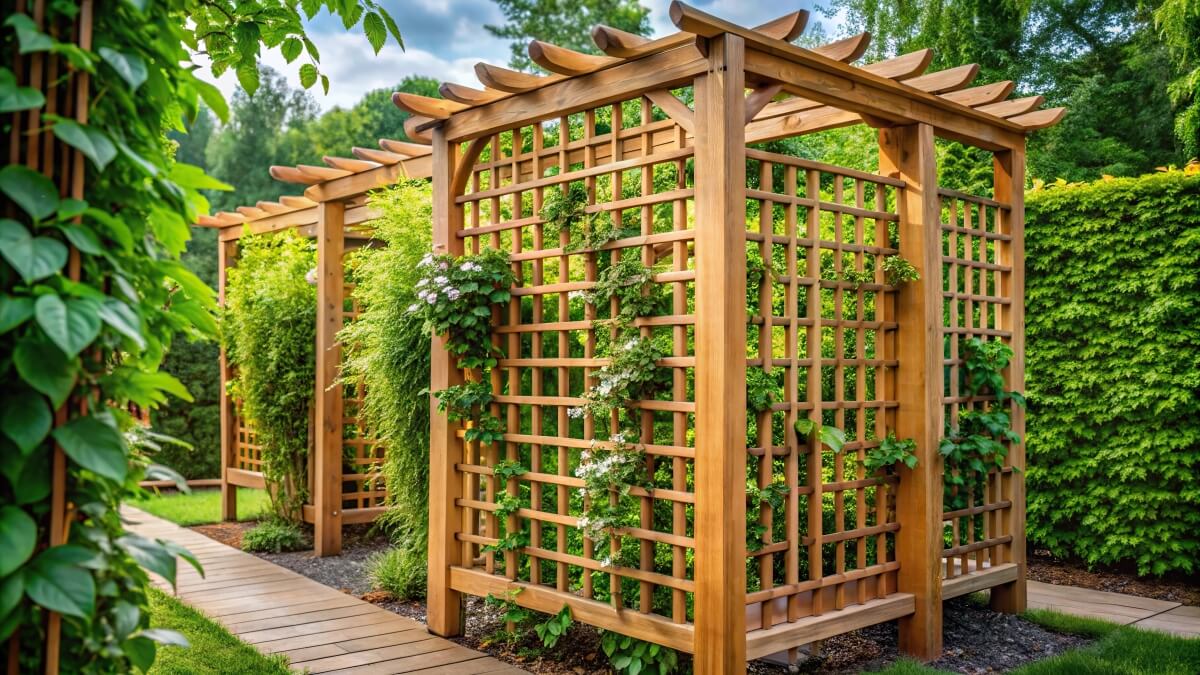
The movable slat system works by rotating or sliding wooden slats on axles or within guides, allowing you to adjust the amount of light, shade and cover in a pergola, terrace enclosure or roller blinds. The choice depends on the function of the shading system, exposure to wind and rain, and the selection of a rotating or sliding mechanism, which requires a sturdier frame. Wider sections are divided into modules to minimise deflection and prevent the mechanism from becoming misaligned.
How does the moving board system work and where does it make the biggest difference in the garden?
The sliding slat system is a solution that allows you to transform your patio, pergola or outdoor structure into a more sheltered or more open space with a single movement – depending on the sun, the wind and whether you want privacy. In practice, it works like a wooden louvre with an adjustable angle, only in a more robust version and designed specifically for a particular garden structure.
At Dąb Gaj Wood, we use this mechanism in projects where user comfort and aesthetics are key, but also where the predictable behaviour of the wood over the years is important.
If you are considering such a solution for a pergola, terrace wall or balcony alcove, the most important thing is to understand how it works movable plank system in everyday use: what powers it, what parts wear out, and how to choose the right timber and cross-sections to ensure there is no play after the season.
A well-designed system should run smoothly, without jerking, and must not jam after rain or in hot weather.
How does the movable board system work in pergolas, patio enclosures and wooden blinds?
The movable board system works by rotating or sliding the wooden slats in guides or on axes, so you adjust the clearance, shade and cover. You'll most often encounter a pivoting version: you angle the boards from almost closed to firmly open, giving you control over the sun and wind. In practice, it's a construction-scale wooden blind rather than a decorative panel.
In pergolas and terrace enclosures, the mechanism is usually manual (crank, pull cord, lever) or designed for motorised operation. In garden roller blinds and side screens, vertical guides and stabilising slats are more commonly used to prevent the wind from blowing the elements out of position.
The key point is that the system of movable boards is designed with installation clearances: wood expands and contracts with changes in humidity and temperature, so it cannot be fitted tightly together.
The standard dimensions that are most convenient to work with in the garden are slats 90–140 mm wide and 20–28 mm thick. For larger areas (e.g. a screen 2.5–3.0 m wide), the whole structure is divided into modules, as long, heavy panels are more prone to sagging and can cause the mechanism to become misaligned.
If the structure is to serve as a side screen next to the terrace, practical heights range from 1.6 to 2.2 metres, depending on whether you simply want to block the neighbours’ view or shield yourself from the wind.
What does the moving board system consist of and what is most likely to wear out in it?
A moving board system consists of lamellas, axles/connectors, guides or support frame and control mechanism, and wear mainly affects the friction points and connectors. The areas where the wood meets the metal suffer the most: bushings, joints, glides and attachment points. If these components are selected too lightly, play and uneven operation appear after a season.
From a structural point of view, the frame to which the entire system of movable boards is attached is important. For garden projects, KVH or BSH timber in the GL24 grade works well, as it retains its dimensions and is more stable than standard sawn timber.
You’ll often find 18×18 cm cross-sections used for load-bearing posts, as they provide a margin of rigidity, particularly when the structure is subjected to additional loads from movable modules and wind.
The most common points that need attention after time are:
- Fasteners and pivot axles - when poorly secured, they can catch play or creak; correction and maintenance at the points of operation is usually sufficient.
- Guides and slides - collect dust, sand and resin, so without cleaning the mechanism starts to go harder.
- The wood's protective coating - when it wears away from touch and friction, the wood absorbs moisture more quickly and holds dimension less well.
A well-made movable board system should not need to be dismantled every year. In practice, the idea is that operating components are accessible and adjustment is possible without demolishing the body.
How much does a movable decking system cost and what does the pricing depend on?
A system of movable decking boards is usually priced as a made-to-measure module, and the cost depends on the surface area, the type of control system, the grade of timber, and whether it is a freestanding unit or part of a larger structure.
As a guide: a simple side screen with adjustment in a single section (approximately 2.0×2.0 m) usually costs several to over a dozen thousand zlotys, depending on the details and finish. The biggest differences in price are down to the mechanics, the quality of the timber and the method of installation.
The cost is also influenced by whether the movable board system works on the pivot axis (angle adjustment) or whether it is a sliding system with guides. Sliding modules tend to be more expensive, as they require a more rigid frame and more precise guidance. If there is also integration with a pergola, slatted roofing or wall cladding, the scope for joinery and on-site fitting increases.
In practice, it is worth adopting a few simple rules that make valuation more realistic:
- The larger the module, the greater the stiffness requirements - with widths of more than 2.5-3.0 m, it is often better to divide the aperture into two fields.
- The more exposed the site (wind, rain on the side), the more important it is to have better coatings and stable structural timber.
- The more adjustment and convenience (e.g. smooth settings), the more the quality of the mechanism and millimetre-accurate assembly is important.
If a moving board system is to operate lightly and yet not teeter in the wind, it cannot be done on thin slats and random fittings. Here, the savings usually come back in the form of amendments.
How do you maintain a moving board system to keep it running smoothly for years?
The sliding board system should be maintained regularly, but without going overboard: the key is to clean the runners and refresh the wood’s protective coating, usually every 1–2 seasons. If the structure is exposed to full sun and rain, it is worth carrying out an inspection after winter, rather than waiting until it starts to become difficult to use.
A well-maintained system of movable planks can last 10–15 years or longer without the need to replace the modules, provided the structure is stable and the timber is properly protected.
On the practical side, I always start with the simple things: removing sand and dirt from the work areas, checking for play on the fasteners and looking at the coating on the edges of the fins. It's the edges that catch water fastest because they are the most heavily used. If you see dulling, overdrying or localised discolouration, it's a signal that it's time to refresh the protective coating.
In garden structures, oil-wax coatings work best because they work together with the wood and are easy to renew without sanding the entire surface down to nothing. In typical patio use, a realistic frequency is:
Highly sunny areas: check every season and refresh usually every 12-18 months. Sheltered areas (under cover, less rain): check every season and refresh every 18-24 months.
If something starts to hook, don't press down forcefully. In 90% cases, it's fine dirt in the slide, minimal loosening, or swelling after long dampness. A quick response saves both wood and mechanics.
If you’re planning to enclose a terrace or build a pergola and want to be able to control the light and privacy easily, it’s a good idea to design a system of movable slats as part of the overall structure from the outset, rather than adding it on at the end. This makes it easier to conceal the fixings, select the right cross-sections and leave space for maintenance, whilst ensuring the whole structure looks cohesive and operates smoothly.
If you need advice on how to sort this out in your space, take a look at the website Dąb Gaj Wood and see how we approach such developments from the design and installation side.
Frequently asked questions
How do I prepare the site for the installation of a moving board system?
The substrate must be stable and level, as even small differences in level can later cause the frame to skew and the lamellas to work harder. Point foundations for the posts, concrete footing or ready-made mounting bases are most often prepared, and when mounting to an existing wall, the load-bearing capacity of the substrate and the insulation run are checked. Before installation, it is also a good idea to leave free service access to the tracks and adjustment points, rather than permanently encasing them.
How long does it take to realise and install a bespoke system?
Typical turnaround time for a bespoke item depends on the season and complexity, but is usually between 4-10 weeks from design approval and measurement. The assembly of a single module (such as a side screen) alone usually takes 1 day, and for a larger terrace or pergola development, 2-5 days must be reckoned with. If foundation and site preparation work is involved, the schedule is extended by the concrete setting time, usually a minimum of several days.
Which timber to choose: KVH, BSH and which construction class?
For load-bearing members and frames, KVH or BSH is the most common choice, as it is a structural timber with better dimensional stability than ordinary lumber. BSH (e.g. GL24 grade) is particularly suitable for longer spans and where you want to minimise warping and torsion. For laths and moving members, the cross-sections and grade are selected for outdoor use, and correct edge and joint protection is also key.
How often to oil and how to care for weather resistance?
In practice, the coating is inspected every season and refreshed usually every 12 to 24 months, depending on sun and rain exposure. The edges of the slats and areas gripped by the hand and working in the mechanism wear out the fastest, so there it is worth reacting point-wise earlier. Regular cleaning of the guides from sand and dirt after winter really extends the life of the mechanics and reduces the risk of wedging after rainfall.
Is a permit needed, can the dimensions/colour be personalised and what is the guarantee?
Dimensions and colours can usually be tailored to suit a particular terrace, pergola or alcove, but the final extent of personalisation depends on the division into modules and wind rigidity requirements. The question of permission or notification depends on the type of structure, its dimensions and local regulations, so it is advisable to check the requirements with your local authority before ordering or to consult with the contractor at the design stage. Warranty terms vary depending on the manufacturer and scope of work, but as standard they cover fabrication and installation assuming regular maintenance and proper use.