


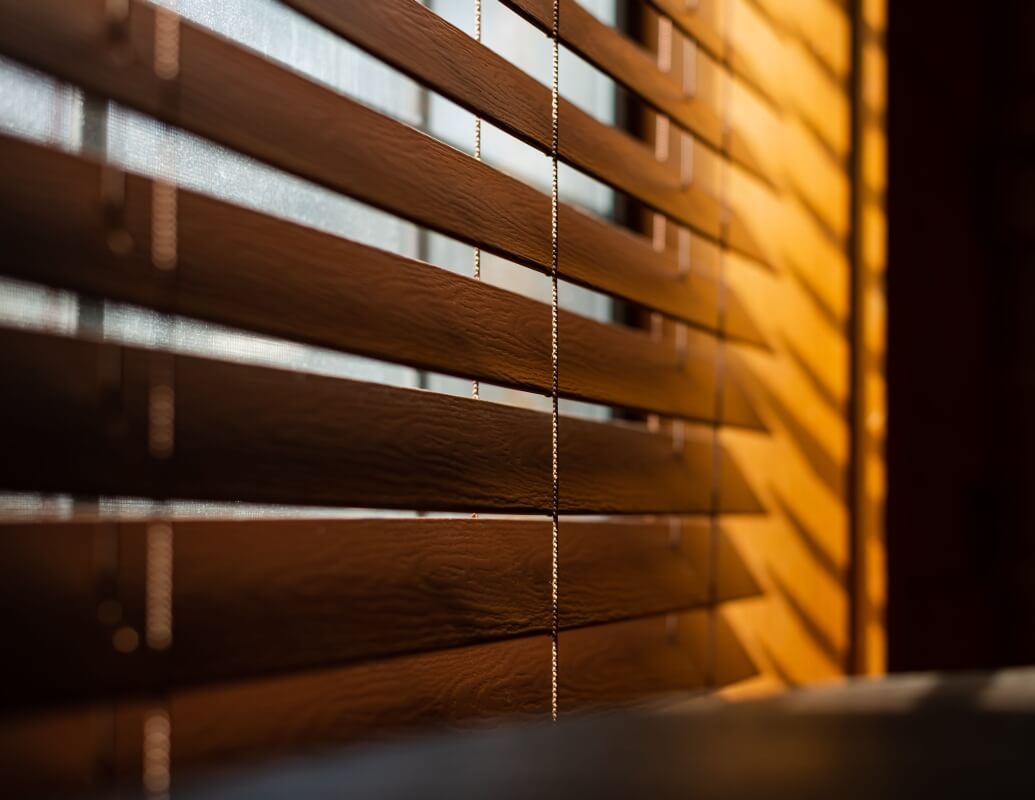
Made-to-measure wooden slatted blinds consist of slat modules set within a rigid frame, in which the angle of the slats controls the amount of light, airflow and privacy without the need for a fixed installation. The choice depends on the division into modules, the method of installation – onto posts, walls or in a recess – and the required degree of closure. Key features include a stable frame made from BSH glued laminated timber and moisture-resistant fittings; for larger openings, two modules are preferable to a single panel.
Are movable made-to-measure wooden blinds a good idea for the patio and garden?
Made-to-measure wooden louvred blinds are one of those terrace accessories that genuinely enhance the comfort of using your outdoor space: they provide shade when you need it, shield you from the wind and improve privacy without making the space feel enclosed.
Dąb Gaj Wood creates such solutions either as part of larger structures (pergolas, canopies, terrace enclosures) or as freestanding screens, tailored to a specific location and intended use.
The biggest advantage is simple: movable wooden blinds made to measure adjust to the light, wind and layout of the terrace, not the other way around. If you want to see what this looks like in practice, check out the customised movable wooden blinds in versions for use on terraces, gazebos and garden buildings.
How do movable made-to-measure wooden blinds work and what do they do in practice?
Movable wooden blinds made to measure are a shutter made of lamellas (boards) set into a frame, in which the angle of the lamellas can be changed mechanically. In practice, this means control of the sun, ventilation and privacy without having to roll up the blinds or put on additional covers.
In the terrace version, you will most often encounter modules with a width of about 90-140 cm and a height of 180-220 cm, because such formats are convenient to install and stable. The laths themselves are usually 20-28 mm thick and about 60-90 mm high (the visible part), and the frame is rigid enough not to work in the wind.
What does this offer on a daily basis? Movable made-to-measure wooden blinds allow you to set three scenarios with a single movement: full open (maximum light), twilight (best comfort in hot weather) and closed (privacy, shelter from low sun and light wind). With well-adjusted slats, you also reduce the heating of glazing and patio doors, which you can feel in the house in summer.
- Light control without loss of ventilation: you position the slats so as to cut off harsh rays but leave air circulation.
- Privacy without the effect of a wall: during the day you can block the view from the outside and still see the garden from the right angle.
- Protection of terrace furnishings: less UV on furniture and terrace flooring means slower fading and less surface cracking.
If you're planning a built-in by the dining area or by the hot tub, movable wooden blinds made to measure are usually more convenient than fixed panels because they don't close off the space permanently and are easier to adjust to the weather.
What type of wood and construction is the best to order movable wooden blinds made to measure?
It is best to order movable timber blinds made to size from dimensionally stable timber and well prepared for the outdoors, as straight laths and a rigid frame are key. In practice, structural glulam (e.g. BSH) for the frames and well-dried timber for the laths, treated with an oil and wax system, work well.
From a structural point of view, what matters is that the frame maintains its geometry. If, for example, a module is 120 cm wide and 210 cm high, a weak frame will start to flex at the first sign of wind, and the mechanism for adjusting the slats will then become misaligned more quickly.
That is why premium solutions use sturdier frame profiles (often around 45–70 mm thick, depending on the format), and in larger panels, the glazing is divided into two modules rather than forming a single large pane.
The important thing: movable wooden blinds made to measure are not just about the wood, but also the hardware and the guidance. The mechanism should have a reserve of strength and the pivot points of the lamellas must be resistant to moisture and dirt. In outdoor solutions, a simple pull rod or slat mechanism works well, as it is less sensitive to getting wet than very delicate gears.
If the louvre is to be part of a larger structure (pergola or gazebo), it is worth looking at the whole thing: 18×18 cm load-bearing posts and a stable beam make all the difference, because the louvre then works within the rigid frame of the building rather than on random fixing points.
How much do movable wooden blinds cost with installation and what does the pricing depend on?
Made-to-measure wooden slatted blinds are usually priced per module or per square metre of the finished blind, as each design has different dimensions, divisions and mounting methods.
Several factors affect the cost, which are immediately apparent on site. Firstly, the size: a 100×200 cm module will be simpler than a 140×240 cm one, as a larger surface area requires a stiffer frame and often additional partitions.
Secondly, the method of installation: the awning is fixed differently to the pergola posts than to a wall, and in yet another way within the span of a terrace recess, where the tolerances are tight.
The third factor is the finish. Movable custom wood blinds protected with OSMO (oil and wax impregnation and finish) cost more than raw wood, but the difference comes back in durability and aesthetics. A well-protected surface absorbs water less, greys more slowly and is easier to refresh without aggressive sanding.
- Dimensions and number of modules: the larger the area and the fewer the divisions, the greater the requirements for rigidity and fittings.
- Type of mechanism: a simpler and robust mechanism is often cheaper to service than complex solutions with a low tolerance to dirt.
- Mounting location: mounting on a pre-fabricated structure is sometimes quicker, but mounting to curved walls or in a difficult recess requires more adjustment.
In order not to overpay, it is advisable to determine from the outset what effect the blind is intended to have: whether it is intended mainly to provide shade, primarily to screen neighbours or to protect from the wind. Movable made-to-measure wooden blinds can be designed for one purpose or as a compromise, but this affects the spacing of the slats and the degree of closure.
How do I maintain my movable wooden blinds to keep them running smoothly and looking like new?
Movable wooden made-to-measure blinds require regular but simple maintenance: cleaning, checking the mechanism and refreshing the protective coating. If you do this systematically, the real lifespan of such an outdoor blind is quietly 10-15 years in very good appearance, and structurally longer.
There are two most important times of the year. In spring, it is a good idea to wash the laths and frame (mild wood polish, soft brush), check that nothing rubs and that no sand has collected at the pivot points. In autumn, it is good to clean the surface again and assess whether the coating is no longer too dry or faded from the sun.
If the blinds face south or west, the oil usually needs refreshing every 1–2 seasons. On the north-facing side, this is needed less often, but in that case you need to make sure that moisture and deposits do not build up.
The key is: don’t wait until the wood has become dull and starts to soak up water like a sponge, because then you’ll end up having to sand it down again instead of simply giving the finish a light refresh.
On the mechanical side, the rule of thumb is simple: the blind is supposed to walk lightly, without jerking. If you feel resistance, dirt at the points of movement or minimal disruption after a windy season is usually to blame. Movable made-to-measure wooden blinds are grateful to be serviced, as long as they have well-matched hardware from the start and are installed in alignment.
If you want to have peace of mind for years to come, adapt your use to the weather: in very strong winds, it is better to set the slats in a position that offers less resistance (often slightly ajar) rather than closing them by force. This is a small thing, but it strongly extends the life of the mechanism and maintains the frame geometry.
If you’re looking for a premium finish and want your blinds to genuinely work to suit your needs, it’s worth ordering made-to-measure wooden blinds as part of a single, end-to-end service that includes design, measurement and installation.
That way, you’ll avoid common problems such as incorrect assembly clearances, slats rubbing against each other and the mechanism operating unevenly, and the whole structure will blend in with the pergola or terrace enclosure; for details of the project and deadlines, it’s best to contact Dąb Gaj Wood.
Read also: Are movable wooden blinds suitable for all seasons?
Frequently asked questions
How do I prepare the ground and the place for the installation of blinds?
The most important thing is a stable and even mounting location: the pergola/canopy posts, the wall or the reveal must be able to bear the loads from wind and sash work. Before installation, it is a good idea to check the risers and levels and leave installation slack, as the wood works seasonally and needs room for adjustment. If the blinds are to stand on an existing structure, prepare access for anchor points and ensure there are no clashes with guttering, lighting or patio doors.
What is the typical lead time from measurement to installation?
As a standard, it takes about 3-6 weeks from measurement and arrangement to installation, depending on the season and the degree of personalisation. Most of the time is taken to prepare the elements, secure the wood for outdoor conditions and fit the mechanism to the module dimensions. For simple modules on a pre-fabricated pergola, on-site assembly usually closes in 1 day.
Can any size, colour and direction of opening be ordered?
Yes, blinds are made to size, but the design usually includes module divisions to keep the frame rigid and the lamellas light. The colour scheme depends on the protection system (e.g. oil/wax) and can be chosen to suit the façade, terrace or joinery, and the degree of coverage can also be determined. The operating direction and method of adjustment (rod, slat, other solution) is chosen according to ergonomics and whether the shutter is to be operated from one or two sides.
Which wood (KVH, BSH or solid plank) will work best?
For frames, BSH is usually the best choice, as it is dimensionally stable and easier to maintain geometry with larger formats. KVH is sometimes a good structural choice in load-bearing elements, but in louvres the cross-sectional fit and the quality of the protection, rather than the name of the material itself, are also crucial. Well-dried timber with a suitable selection is used for the laths, as straight and stable boards reduce the risk of twisting and uneven operation of the mechanism.
Do you need planning permission and what is the guarantee?
Blinds on their own as a terrace feature usually do not require a permit, but if they are part of a new pergola, canopy or development, the formal obligations depend on the dimensions, method of foundation and local regulations. In practice, it is advisable to check with the municipality/city council before ordering whether a notification is sufficient for the planned construction or whether a permit is needed. The warranty conditions depend on the manufacturer and the finishing system, and most often cover the structure and mechanism, assuming correct maintenance and use as recommended.